
Mapping the self: a guide to emotional healing and wholeness
By Analog Counseling & Consulting Services
Emotions Aren’t the Problem—They’re the Map
Emotions are your body’s internal GPS. They aren’t obstacles—they’re signals that something needs attention.
They arise before conscious thought and aim to help you regulate, connect, and adapt. But when we block emotions—due to trauma, fear, shame, or survival needs—they go underground and show up as distress, anxiety, numbness, or disconnection.
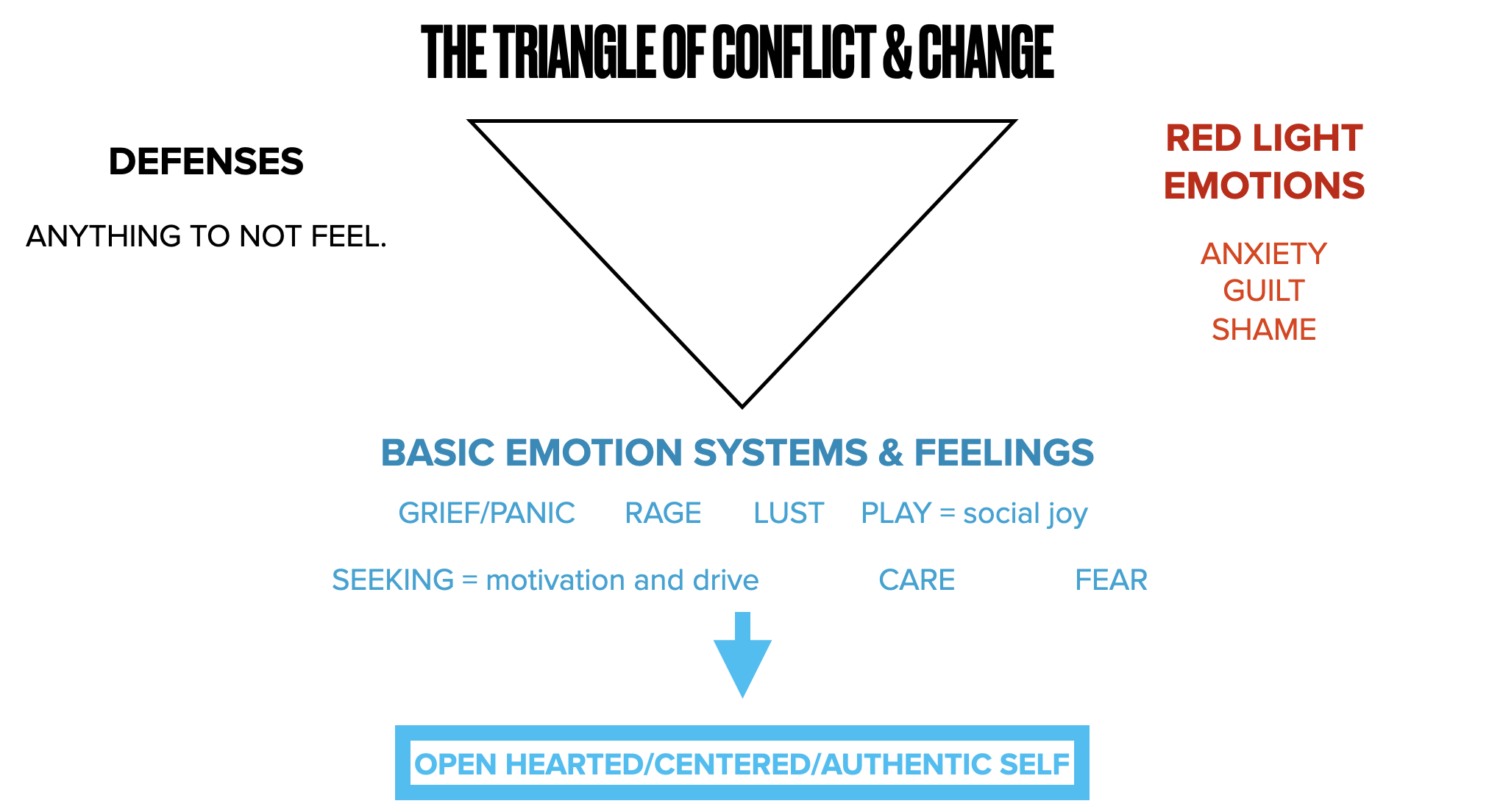
The Triangle of Conflict and Change: A Map for Healing
Based on the work of Hilary Jacobs Hendel, Diana Fosha, and David Malan the Triangle of Conflict and Change helps us move from distress and defenses toward clarity and connection.
1. Defenses (Top Left)
Anything we do to avoid feeling:
- Overthinking
- Numbing
- Blaming
- Scrolling
- Addictions
- Perfectionism
2. Inhibitory Emotions (Top Right)
These are the “red lights” of our emotional system:
- Anxiety: Am I safe?
- Shame: I am bad.
- Guilt: I’ve done something bad.
They block access to deeper core emotions.
3. Core Emotions (Bottom Point)
These are biological, adaptive feelings:
- Grief / Panic
- Rage
- Lust
- Play (Social Joy)
- Fear
- Care
- Seeking (Motivation / Curiosity)
Trauma: A Stuck Emotional Response
Trauma is not the event itself—it's what the nervous system does after the event.
When emotional responses can't complete (crying, running, connecting, yelling), they stay stuck. The nervous system gets trapped in fight/flight/freeze. Instead of completion, we move into coping (i.e. defenses).
What Inhibitory Emotions Feel Like
Anxiety
- Racing heart
- Tight chest
- Breathlessness
- Dizziness
- Racing thoughts
- Nausea
Guilt
- Muscle tension
- Crying
- Restlessness
- Insomnia
Shame
- Feeling exposed
- Frozen
- Wanting to hide
- Blushing or hot
- Feeling “less than”
The Threat Response Cycle
Novelty → Orient → Assess → Respond → If needed Fight/Flight/Freeze → Rest
In trauma, completion of the response doesn't happen so we never get to the “rest” part. The system stays alert, reactive, and to cope with that dysregulation we dissociate through using defendes. The body never feels safe enough to feel as long as the original dysregulation maintains without support or help.
How to Work the Triangle
1. Undo the Defenses
- Notice what defense you're using
- Reflect on how it feels to be defended
- Thank the defense—it's trying to protect you
- Gently ask it to step aside and observe what happens
2. Calm and soothe the nervous system from the Inhibitory Emotions
Use somatic tools like:
- Name that you are feeling a red light emotion
- Physiological Sigh (i.e. the double inhale)
- Orienting to notice you are safe and to give your nervous system a chance to reset (a specific Somatic Experiencing skill)
- Focusing on lowering heartrate, softening muscles, deepening breath, etc.
3. Build Safety With Emotions
Use somatic tools like:
- Voo breathing
- Grounding (feet, breath, body awareness)
- Swaying, walking, rocking
- Journaling, art, or music to evoke and explore emotion
4. Practice Feeling in Safe Ways
- Start slow—don’t flood yourself - focus on restful/calm/strong/positive feelings first
- If you start to notice tension in your body, as long as it's not overwhelming or flooding, stay with it until the wave of actation dies down stay with the sensations themselves to do this
- After a wave of activation and de-activation journal about the feelings and memories that you experienced
- Share how you feel with someone you trust
- Notice how it feels to be heard
Two Powerful Healing Modalities
Somatic Experiencing (SE)
Helps the body complete stuck trauma responses through:
- Grounding & orienting
- Gentle touch work
- Tracking bodily sensation
- Building capacity to feel safely
EMDR Therapy
A structured process that helps “digest” traumatic memories:
- Recall a memory while using eye movements or tapping
- Let feelings, images, and beliefs surface
- Notice how the memory shifts or lightens over time
Your Healing Goals
The goal isn’t to “get rid” of emotions. It’s to feel them safely, let them guide you, and return to your authentic self.
You can learn to:
- Calm your physiology
- Understand your emotional cues
- Feel without shutting down or overreacting
- Reconnect to others in meaningful ways
Summary: Mapping the Self
- Emotions are Signals: Not problems. They tell us what we need.
- Trauma is Dysregulation: Not just the event. It’s what sticks.
- Healing = Feeling: Safely, with support, and in the body.
- Defenses + Red Light Emotions = Blocks
- Core Emotions = Authenticity + Adaptation
- Therapies like SE and EMDR help complete the cycle
References
- Hendel, H.J. (2018). It’s Not Always Depression
- Panksepp, J. & Biven, L. (2012). The Archaeology of Mind
- Porges, S. (2017). The Pocket Guide to the Polyvagal Theory
- Levine, P. (2010). In an Unspoken Voice
- Solms, M. (2021). The Hidden Spring
- Badenoch, B. (2017). The Heart of Trauma
*If you ever become flooded or overwhelmed stop the exercise and comfort/soothe yourself. Then consider waiting to engage the feelings again until with a professional.