
Understanding the change triangle and it’s relation to somatic experiencing
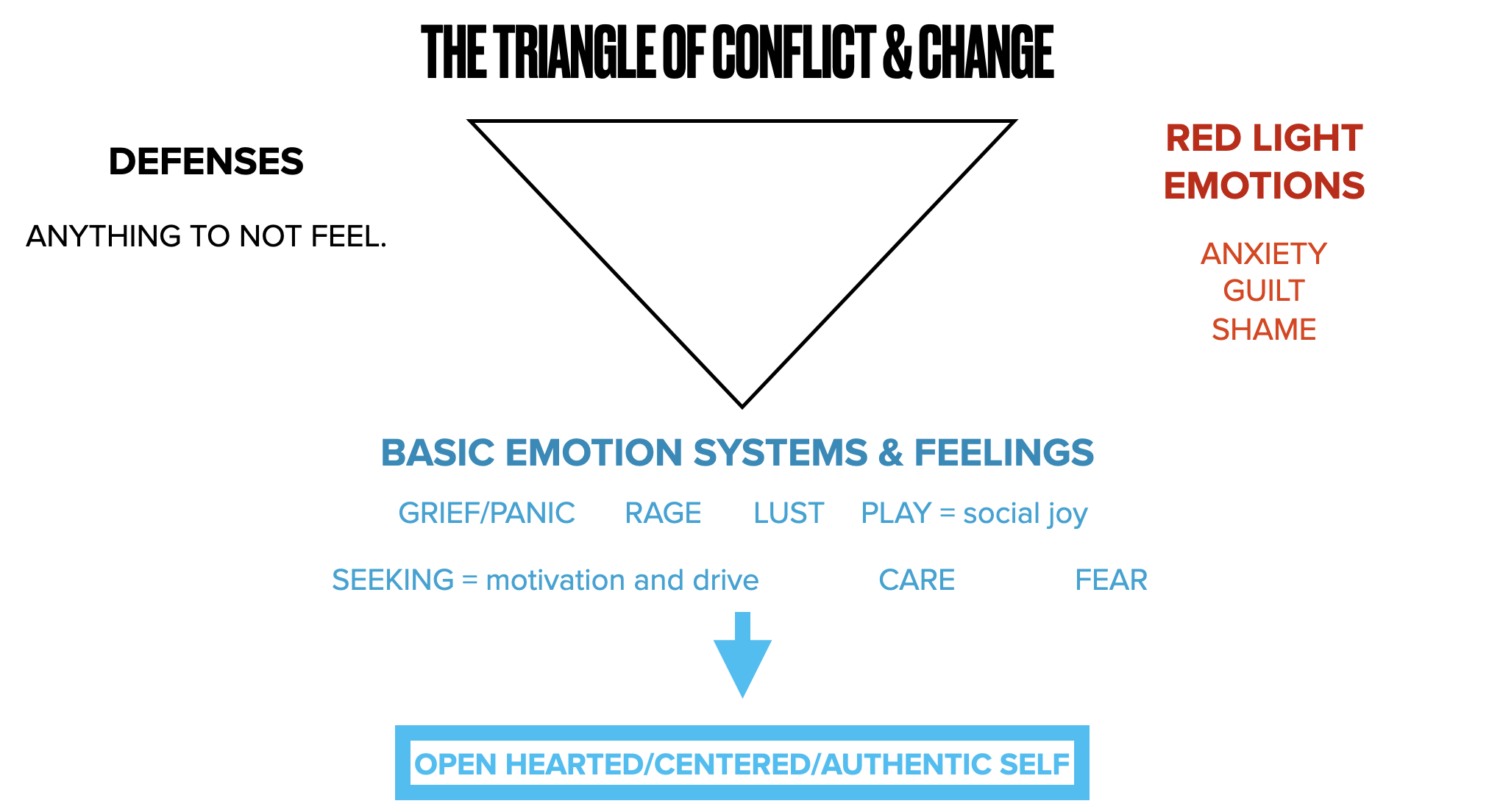
This is an image I made that is slightly different than Hendel or Fosha or Malan’s triangle. It uses Panksepp’s basic emotion systems and integrates in Porges’ Polyvagal Theory.
The Change Triangle is a practical map of emotions developed by Hilary Jacobs Hendel, grounded in accelerated experiential dynamic psychotherapy (AEDP), affective neuroscience (especially the work of Jaak Panksepp), and psychodynamic theory. It's designed to help people move from states of anxiety, shame, and depression toward core emotions, open-hearted states, and authentic connection with self and others.
Overview of the Change Triangle
The triangle has three points:
Top Corners (Defensive & Inhibitory Emotions):
Defensive behaviors (e.g., sarcasm, people-pleasing, intellectualizing) block emotional experience.
Inhibitory emotions include (I used the title “Red Light Emotions” above):
Anxiety
Shame
Guilt
These act like red lights, blocking or overriding core emotional experience.
Bottom Point (Core Emotions):
These are universal, biological, adaptive emotional responses hardwired in the brain.
Core emotions include (again - in the image above I’m using Panksepp’s core emotion systems vs the emotion list from Hendel as listed below):Anger
Sadness
Fear
Joy
Excitement
Disgust
Sexual excitement
Authentic Self (Middle of the Triangle):
When core emotions are felt and processed fully, a person can access their authentic self, characterized by clarity, calm, confidence, and connection.
Inhibitory Emotions in the Nervous System
1. Anxiety
A global arousal signal of the autonomic nervous system (ANS), especially the sympathetic branch (fight or flight). It arises when core emotions are experienced but cannot be tolerated or expressed safely.
Brain regions:
Amygdala: hyperactive in threat detection
Hypothalamus: triggers HPA axis → cortisol release
Insula: processes internal sensations (interoception)
Prefrontal cortex: may attempt to suppress emotional awareness
Somatic markers: Rapid heartbeat, muscle tension, restlessness, tight chest, shallow breathing
Reference: Porges, S. (2017). The Pocket Guide to the Polyvagal Theory; LeDoux, J. (2015). Anxious: Using the Brain to Understand and Treat Fear and Anxiety
2. Shame
An inhibitory emotion triggered by perceived failure to meet social or internal standards. It shuts down expression of vulnerable states.
Biological function: Social protection. Prevents ostracism by curbing behavior that could threaten connection or belonging.
Brain regions:
Medial prefrontal cortex: self-evaluation
Anterior cingulate cortex: emotional pain and conflict
Periaqueductal gray: immobility response (freezing)
Somatic markers: Collapse posture, averted gaze, facial flushing, desire to hide or disappear
Reference: Nathanson, D. L. (1992). Shame and Pride: Affect, Sex, and the Birth of the Self; Gilbert, P. (2003). Evolution, Social Roles, and the Differences in Shame and Guilt
3. Guilt
Another socially-oriented inhibitory emotion, guilt helps preserve social bonds by motivating reparative actions when behavior conflicts with moral values.
Brain regions:
Ventromedial prefrontal cortex: decision-making tied to values
Temporal parietal junction: perspective-taking
Insula: subjective emotional awareness
Somatic markers: Sinking stomach, tight chest, sense of heaviness, tears
Reference: Zahn, R. et al. (2009). “Social Concepts Are Represented in the Superior Anterior Temporal Cortex.” Proceedings of the National Academy of Sciences
Why They Block Core Emotions
Inhibitory emotions function like internal brakes. They arise when core emotions trigger conflict, fear of rejection, internalized shame scripts, or trauma-based reactions. For example:
Feeling anger → triggers shame (“I’m bad for feeling this”) → emotion gets blocked
Feeling sadness → triggers anxiety (“If I cry, I’ll lose control”) → body tightens, emotion suppressed
Rather than expressing the core emotion, the person may default to defensive behaviors (e.g., pleasing, avoiding, dissociating).
Somatic View: How They Exist in the Body
Peter Levine's Somatic Experiencing and Porges’ Polyvagal Theory explain that inhibitory emotions often result from overcoupling — when activation of core emotion is paired with danger signals from the body.
The nervous system constricts, narrows awareness, and attempts to “shut down” to maintain regulation and social safety.
Over time, chronic reliance on inhibitory emotions leads to:
Autonomic dysregulation (chronic sympathetic or dorsal vagal dominance)
Disconnection from felt sense
Reduced affect tolerance and expression
Reference:
Levine, P. (2010). In an Unspoken Voice
Panksepp, J. (2012). The Archaeology of Mind
Hendel, H. J. (2018). It’s Not Always Depression