
Trauma Isn’t Intensity — It’s What the Nervous System Learns
When people hear the word trauma, they often picture something overwhelming: extreme fear, intense emotion, or a catastrophic event. And while trauma can involve intense experiences, defining it primarily by emotional intensity actually misses the heart of the matter. Trauma is not best understood as how big something felt — but as what the nervous system learned when survival was at stake.

When people hear the word trauma, they often picture something overwhelming: extreme fear, intense emotion, or a catastrophic event. And while trauma can involve intense experiences, defining it primarily by emotional intensity actually misses the heart of the matter. Trauma is not best understood as how big something felt — but as what the nervous system learned when survival was at stake.
From a nervous-system perspective, trauma begins with threat. When we perceive danger, the body mobilizes automatically to protect us through fight, flight, or freeze. This mobilization requires a rapid surge of energy — heart rate increases, muscles tense, attention narrows. This temporary dysregulation is not a problem; it is the body doing exactly what it is designed to do.
Under normal circumstances, that survival energy is spent. We run, resist, escape, or orient toward safety. Once the threat passes and the energy is discharged, the nervous system returns to its baseline rhythm of regulation and flexibility.
Trauma occurs when that process is interrupted.
When a threat cannot be escaped, fought, or fully responded to — because of powerlessness, overwhelm, developmental immaturity, or relational constraints — the nervous system is forced to cope rather than complete the survival cycle. The energy meant for action remains trapped in the body. This unresolved dysregulation is profoundly uncomfortable, and the system adapts in whatever way it can to endure.
Over time, this unfinished survival response becomes encoded as learning.
As Mark Solms explains in The Feeling Brain, affect is fundamentally tied to homeostasis — the body’s drive to regulate internal states. Trauma represents a disruption in this regulatory process. The system does not simply remember what happened; it remembers how it survived.
Similarly, Stephen Porges shows through Polyvagal Theory that our nervous systems continuously assess safety and danger beneath conscious awareness. When safety cannot be restored, the system defaults to defensive strategies — hyperarousal, collapse, shutdown — not as pathology, but as protection.
Crucially, the coping strategies used during the original threat often replace instinctive responses in the future. Instead of fluid fight or flight, the body replays learned patterns. This is why trauma can show up in two seemingly opposite ways: explosive emotional reactions that feel disproportionate to the present moment, or a puzzling absence of response when action would be appropriate. In both cases, the nervous system is responding to past threat in the present.
As Allan Schore emphasizes, trauma is ultimately a disorder of affect regulation. It is not the event itself that defines trauma, but whether the nervous system could return to regulated flow afterward — especially in the presence of attuned support.
Understanding trauma this way reframes healing. The work is not primarily about revisiting intense emotions or retelling the story in greater detail. It is about helping the nervous system complete what was once impossible: restoring regulation, releasing trapped survival energy, and relearning that safety and responsiveness are possible now.
Trauma is not intensity. It is unfinished survival — and the body remembering how it had to cope when there was no other choice.
Why Belonging belongs with DEI
Belonging is an important addition to Diversity Equity & Inclusion that impacts our nervous systems and helps DEI to achieve its goals. Find out how and why.
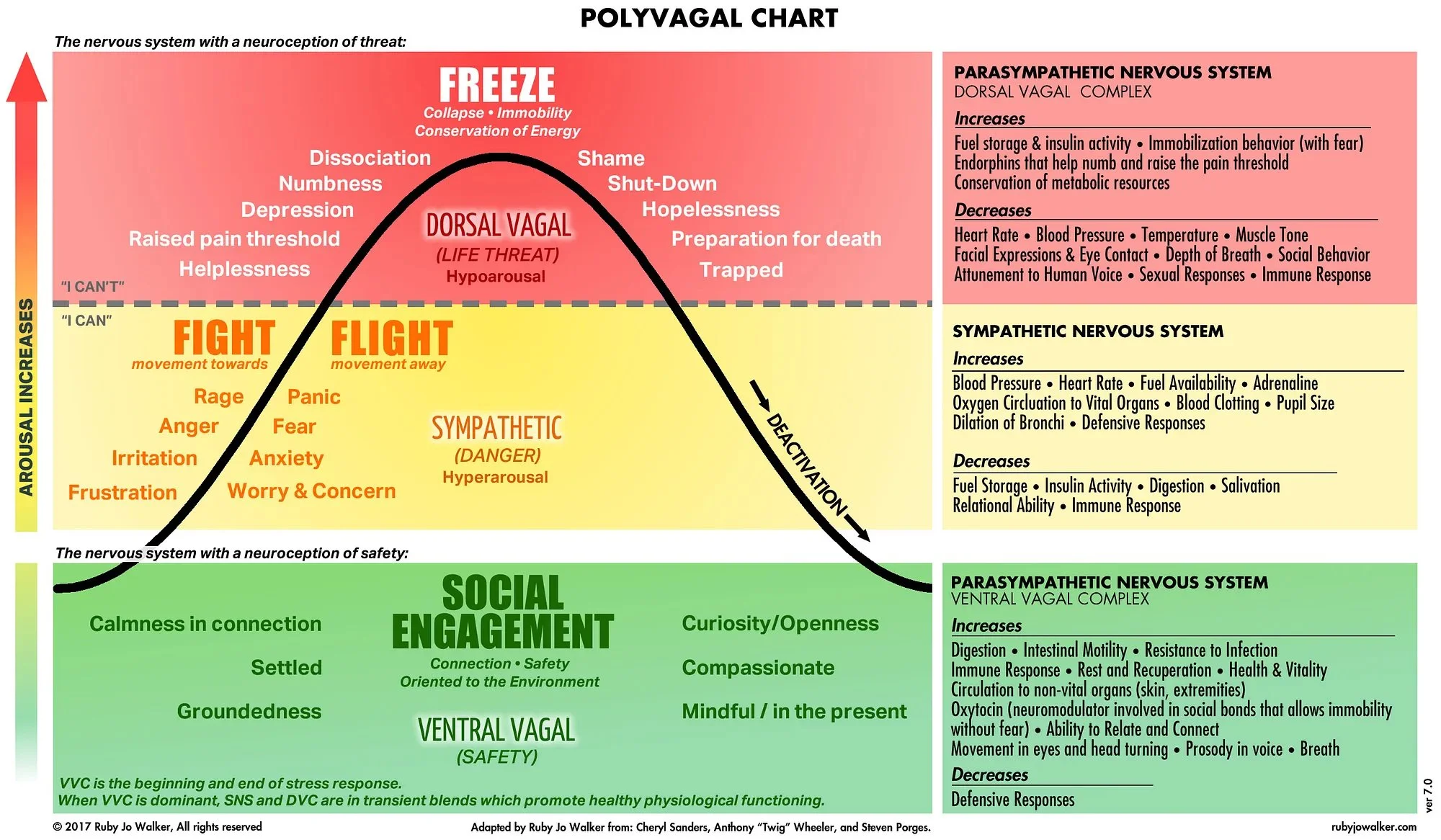
As you can see from the image above, the highest stress point causes freeze. Freeze happens on a spectrum. In the work place it might look more like going quiet in a meeting, not speaking up against a co-worker or supervisor who is being inappropriate, allowing others to take credit for one's own ideas or work, laughing and going along with things that make one feel sick inside, etc. Diversity helps us widen who is a part of the work place. This is a value to the company because it brings in more perspectives that will bring more collective wisdom. But because diversity can be limited by bias to certain categories (e.g. diversity in age but not in race, gender, etc.) Equity helps diversity stay accountable. Inclusion does the same for Equity by not only creating seats at the table for people but ensuring they have a voice. Belonging continues this trend of helping the previous letters meet their goals. With all of DEIB you are increasing psychological safety in the work place which helps people have a better chance of staying in the green of social engagement (this is good for creativity, problem solving and productivity) and out of the yellow of fight or flight and the red of freeze. Belonging brings this home by helping people feel that their inclusion is not a burden, that their personal experience is not alien or isolated but understood by the community of their workplace. Belonging helps people feel they fit. When people feel they fit they can naturally be authentic and have a voice easier. This is how Belonging helps Inclusion meet its goals and makes the green of social engagement even easier.
#DEI #DEIB #PsychologicalSafety #Polyvagal #Belonging