

Why Panic Can Feel Like It Comes From Nowhere
A companion piece to "Panic Attacks Aren't About Fear." Why panic so often hits without warning, and what the divided brain has to do with it.

One of the strangest things about panic is how often it arrives without a story attached. There's no clear reason, nothing you can point to, just the alarm going off in the middle of an ordinary moment.
In an earlier piece, I wrote about panic as an attachment alarm rather than a fear response. Panic isn't your brain asking "am I in danger?" It's an old, loud signal built to maintain connection, telling you that you're disconnected right now, or convinced that disconnection is about to happen. That system, which researchers call PANIC/GRIEF, runs on different chemistry than fear does and directly affects your breathing, heart rate, and pain sensitivity, which is why the alarm shows up as a full-body event rather than just a thought.
What I want to get into here is a different question. Why does the alarm so often go off with no obvious trigger? Why does it feel like it's coming from nowhere?
Two kinds of attention
I think part of the answer has to do with how the two halves of the brain handle information differently, an idea the psychiatrist Iain McGilchrist has spent much of his career working out.
His argument isn't the old, oversimplified version you may have heard, that the left brain does logic and the right brain does creativity. McGilchrist's case is that the two hemispheres aren't divided by subject matter at all. They're divided by the kind of attention each one pays to the world. Both hemispheres are involved in most of what the brain does. They just interact with experience in different ways.
The right hemisphere takes in the whole picture at once: context, relationship, body state, the things that are true but haven't been put into words yet. It's comfortable holding something ambiguous without rushing to resolve it. The left hemisphere works differently. It wants the explicit, the categorized, the already-known. It's fast and confident, and according to McGilchrist, it doesn't know what it doesn't know. If something doesn't fit a category it already has, the left hemisphere tends to filter it out rather than sit with the uncertainty.
McGilchrist also argues that the right hemisphere is more closely tied to the body, to reading relational and emotional cues, and to intense emotional states in general, especially the harder ones like fear and distress.
A signal with nowhere to go
Put those two pieces together and it starts to make sense how you can know something and not know it at the same time.
It's entirely possible for your right hemisphere to pick up on something real: a shift in someone's tone, a withdrawal, a relationship that's fraying, a sense that you're more alone in a room full of people than you should be. All of that can register well before it can be put into words or sorted into a category the left hemisphere will accept. If the left hemisphere can't find a clean, explicit story for what's being sensed, it may not integrate the signal at all. The information doesn't vanish. It just doesn't make it into the version of events you're consciously telling yourself.
So the body notices something and signals it, but the signal has no way into the ordinary channel of thought and language. This might be part of why Freud paid such close attention to slips of the tongue, words that come out unintended and seem out of place, and to dream interpretation, even though he wouldn't have described it in these terms. Both were attempts to reach content that was present but blocked from conscious, verbal access. The PANIC/GRIEF system doesn't need permission from your conscious narrative to act. If the felt sense of disconnection is strong enough and the explicit story isn't catching up to it, the alarm keeps escalating until it's loud enough that you can't ignore it. That's one way to understand why panic so often hits with no obvious trigger. The trigger was there. It just didn't pass through the part of the brain that explains things to you in words.
Why this matters for treatment
This is a contested area of neuroscience. McGilchrist's broader claims about the hemispheres have real critics, and some argue he overstates how cleanly these functions divide. So know that this isn't settled fact.
But the narrower point, that something can be accurately sensed in the body and in relationship before it's consciously articulated, fits well with what's already known about how the PANIC/GRIEF system works. It doesn't wait for you to have a sentence ready. It acts on what's felt, not on what's been said yet.
That has a practical implication. If the original signal never passed through the part of you built to name, define, and explain things in words, then reassuring yourself in that same verbal mode is less likely to help than something that can reach the signal where it actually lives. You can tell someone, accurately, that there's no danger in the room, and it can still miss the point, because the alarm was never about the room. This is a big part of why somatic and body-based approaches tend to reach panic in a way that talking alone doesn't. The work isn't just building a better explanation. It's helping the part of you that senses things before it can name them learn, slowly, that it's not as alone as it fears, and that it now has more capacity to handle grief and aloneness than it did back when it first learned to be afraid of them.
Reference notes: McGilchrist's claims about hemispheric attention styles, the right hemisphere's role in holding ambiguity and context, the left hemisphere's tendency toward premature categorization and closure, and the right hemisphere's closer relationship to bodily and relational awareness, come from his 2009 book The Master and His Emissary: The Divided Brain and the Making of the Western World and his 2021 follow-up The Matter with Things. These claims are influential but not uncontested. Michael Spezio, a psychologist at Scripps College, published a critical assessment in 2019, "McGilchrist and hemisphere lateralization: a neuroscientific and metaanalytic assessment," in the journal Religion, Brain & Behavior, arguing that recent meta-analyses do not support the sweeping, oppositional picture of hemispheric difference McGilchrist describes. The connection between this framework and panic attacks specifically is my own synthesis, drawn from putting McGilchrist's model of attention alongside the PANIC/GRIEF research of Jaak Panksepp covered in the companion piece, not a claim McGilchrist has made himself.

Panic Attacks Aren't About Fear. They're About Being Left.
Most panic treatment targets fear. But panic and fear run on separate systems in the brain, with different chemistry, different circuitry, and different jobs. Understanding which one is actually firing changes what kind of help works.

Most people describe a panic attack the same way. It felt like dying. Like the room was closing in. Like something terrible was about to happen. So we treat panic like a fear problem. We teach breathing exercises, we challenge catastrophic thoughts, we tell the nervous system "you are safe right now," and sometimes that helps.
But it doesn't always help. I think that's because we're answering the wrong question. Panic isn't your brain asking "am I in danger?" It's an alert. An old, loud signal whose entire job is to maintain connection, by telling you, urgently, that you are disconnected right now or convinced that disconnection is about to happen.
Two different alarm systems
Your brain has more than one way to sound an alarm, and they're not the same circuit doing the same job at different volumes.
FEAR is the system that responds to a predator, a car swerving into your lane, a hand on a hot stove (by the way when something is all caps it means it’s a label for a brain system, when it’s not it means it is labeling an emotional feeling). It runs through the amygdala, it's fast, and it's built for immediate physical threat. This is the system most anxiety treatment is designed to address.
PANIC is different, and researchers actually call it PANIC/GRIEF, because it's one system with two faces. It runs a separate route from FEAR, through deep midbrain structures up to the anterior cingulate cortex, and it isn't regulated by the same threat chemistry. It runs largely on your body's own opioid system, the same chemistry involved in bonding and the comfort of closeness. When that opioid supply drops, the alarm goes off.
PANIC/GRIEF is unusual among the seven basic emotion systems in that its name captures two distinct phases of feeling. When panic does not result in feeling secure in connection or attachment again, or we have given up hope of that happening, our system collapses into the other side of that coin: an experience of grief. Grief is what it feels like when connection is already lost. It's the helplessness, the pain of isolation, the collapse that comes when there's nothing left to do about it. The feelings of panic come before that. PANIC's job isn't to cause us to brace for danger. It's to sound the alarm loudly enough, and urgently enough, that connection gets restored before it's lost for good. A panic attack is your system raising every biological and emotional signal it has, fast, because as far as it's concerned, the only thing standing between you and that collapse is whether the alarm works.
This is the same pattern researchers have long described in young mammals separated from a caregiver. First an active, distressed protest: calling out, searching, trying to restore contact. Only later, if reconnection doesn't come, a collapse into something quieter and more despairing. Panic is the protest call. It exists to bring someone back, or to bring you back to yourself, before the despair sets in.
This is also why a panic attack so often doesn't match the size of whatever triggered it. You're not overreacting to a small thing or having symptoms out of nowhere. A fast, old part of your brain has registered that the helplessness of isolation might be coming, and it's throwing everything it has at preventing that outcome, before you've even had time to name what's happening.
What "disconnection" actually means here
Surprisingly, the PANIC/GRIEF system doesn't only fire when someone physically leaves the room. It fires on a prediction (remember, the brain is a prediction machine, as neuropsychoanalyst Mark Solms has argued), and what it's predicting is whether GRIEF is about to arrive.
Underneath every panic attack is a fast, mostly unconscious assessment running on three things at once. A memory of what that helpless, isolated collapse has felt like before. A prediction about whether it's about to happen again right now. And a read on both yourself and the other person: whether you can survive being without them, whether they're still actually with you, whether this is the moment you finally fall into that state you already know.
That's why panic can show up in places that have nothing to do with relationships on the surface. A work presentation. A crowded store. A plane. What's actually being evaluated underneath isn't your presenting skills, the room, or the plane. It's closer to: "if this goes badly, will I end up alone with no way to fix it, and has that helplessness happened to me before?" If your history has taught your nervous system what that collapse feels like, your brain doesn't wait for it to arrive. It panics early, trying to head it off, because heading it off is the whole point of the system.
What's happening in your body
This system has a different chemical signature than fear does, and that's part of why fear-based treatment doesn't always land.
Where the FEAR system runs largely on CRF, norepinephrine, and the threat-detection chemistry of the amygdala, the PANIC/GRIEF system runs primarily on the brain's own opioids, along with oxytocin and prolactin, the same chemicals involved in bonding and the comfort of closeness. In animal studies, giving opioids is the single most effective way to quiet a separated infant's distress calls. That tells you what the alarm is actually built to respond to. Not threat reduction. Reconnection. It goes off when that opioid-driven sense of closeness drops, and it shuts off when closeness is restored, not when danger passes.
Here's the piece that explains what a panic attack actually feels like in the body. This circuit doesn't stop at producing an emotional signal. It directly regulates breathing, heart rate, and pain sensitivity as part of its basic function, and its territory overlaps with structures that also drive the body's fear and arousal chemistry, including norepinephrine. So when this alarm fires, it doesn't stay contained to "I feel disconnected." It recruits your sympathetic nervous system, the same system responsible for fight-or-flight, and that's where the racing heart, the shallow breathing, the sweating, and the trembling come from. The alert has to be loud enough, physically, to actually move you or someone else to act. A quiet signal doesn't restore connection. A racing heart and a flood of adrenaline-like chemistry does, because it's built to be impossible to ignore.
This is also why a panic attack can feel indistinguishable from a heart attack or a respiratory emergency. It isn't your imagination and it isn't "just anxiety." Your sympathetic nervous system has activated for real, your heart rate has climbed for real, your breathing has changed for real. The alarm is bodily because it has to be. A signal whose entire purpose is to summon connection back doesn't work if it's subtle.
The old proof: two problems, two drugs
Long before anyone had mapped this circuitry, clinicians stumbled onto evidence that panic and anxiety are actually two different problems, by accident, through a drug that only fixed one of them.
In 1960, a psychiatrist named Donald Klein was working at Hillside Hospital in Queens, New York, treating patients with severe anxiety attacks and agoraphobia. He was testing imipramine, one of the first antidepressants, which had only been introduced a few years earlier. What he found surprised him. Imipramine stopped the panic attacks themselves, often within weeks. But it didn't touch something else these patients were still carrying: the fear of having another attack. That anticipatory dread, and the avoidance behavior built around it, the not going to the store, the not getting on the plane, stuck around long after the attacks had stopped. It took a different kind of medication, an anti-anxiety drug, to work on that part.
Klein published this finding in 1962, and he called his method "pharmacological dissection." The logic was simple. If one drug stops the attacks and a different drug is needed for the fear of the attacks, you're probably not looking at one problem with two symptoms. You're looking at two different mechanisms that happen to sit next to each other. That observation eventually helped separate panic disorder from generalized anxiety disorder in psychiatric diagnosis, decades before anyone could point to the separate neurochemistry behind it.
It's a striking piece of history to sit next to everything above. Clinicians noticed, just from watching patients respond to medication, that panic and anxiety about panic were not the same thing and did not resolve through the same channel. That's the same split this whole piece has been describing, just discovered from the outside in, one prescription at a time, instead of from the inside out through brain circuitry.
Why this changes what helps
If panic is fundamentally a fear response, the treatment is exposure and reassurance. Prove to your nervous system that the room is not, in fact, dangerous.
If panic is fundamentally an attempt to maintain connection, the treatment has to focus on that. It's not enough to convince your nervous system that the plane won't crash, and it's not enough to slow the breathing once the sympathetic nervous system has already taken over, although that can help in the moment. The deeper work has two parts. One is with the prediction itself: what your body believes will happen, and what memory that belief is built on. The other is with your capacity to actually tolerate the thing panic is working so hard to avoid. As long as grief feels unsurvivable, the system has every reason to keep sounding the alarm rather than risk falling into it. Part of the work is building enough safety and support that helplessness and isolation, if they do show up, are no longer the catastrophe your body believes them to be.
This is part of why somatic and trauma informed approaches often reach panic in a way that pure cognitive reassurance doesn't. You can't think your way out of a prediction your body learned before you had words for it, and you can't think your way into trusting that grief, if it comes, is survivable. That trust tends to get built through relationship, through the body, through slowly proving to your nervous system, in small doses, that the helplessness it's so afraid of isn't the end of you.
The question underneath the question
If you've had a panic attack and wondered why "you're safe" never really helped, this might be why. Your nervous system wasn't asking about safety from harm. It was trying, urgently, to keep you from falling into a helplessness it’s known before.
That's not a flaw in your wiring. It's an old, well-intentioned system working as hard as it can to keep you from a pain it has every reason to believe is coming, sometimes in situations where that pain was never actually on the way. Understanding that doesn't make the panic disappear. But it changes what you're treating. You're not just talking your body out of a false alarm. You're slowly teaching it that even if grief came, you wouldn't be as alone in it as it fears.
An important note: most current clinical guidelines still treat panic attacks as an exaggerated fear response centered on the amygdala. The separation based view laid out here is a real, published alternative within affective neuroscience, but not something every researcher or clinician would sign off on. I find it more clinically useful for a lot of what shows up in the room, but it is a minority position within panic disorder research specifically, even though the PANIC/GRIEF system itself is well established as distinct from FEAR in the broader affective neuroscience literature.
References Used for this: The distinction between the FEAR and PANIC/GRIEF systems, including their separate neuroanatomy (amygdala and dorsal periaqueductal gray for FEAR; anterior cingulate, bed nucleus of the stria terminalis, and periaqueductal gray for PANIC/GRIEF) and their different core chemistry (CRF and norepinephrine for FEAR; endogenous opioids, oxytocin, and prolactin for PANIC/GRIEF), comes from the affective neuroscience research tradition built by Jaak Panksepp. It's summarized well in a 2020 paper by Gianni Francesetti, Antonio Alcaro, and Michele Settanni, "Panic disorder: attack of fear or acute attack of solitude? Convergences between affective neuroscience and phenomenological-Gestalt perspective," published in Research in Psychotherapy: Psychopathology, Process and Outcome. The protest and despair pattern in separated young mammals draws on John Bowlby's attachment research. The role of the PANIC/GRIEF circuit in directly regulating breathing, heart rate, and pain sensitivity, and the finding that opioids are the most effective known way to quiet separation distress calls in animal studies, are also drawn from that same research tradition. The sympathetic nervous system's role in producing panic attack symptoms such as rapid heart rate, shallow breathing, and sweating is well established in the clinical panic disorder literature more broadly. The imipramine finding comes from Klein DF, Fink M, "Psychiatric reaction patterns to imipramine," American Journal of Psychiatry, 1962;119:432-438, with later work on benzodiazepines and anticipatory anxiety summarized in Zitrin, Woerner, and Klein, 1981. Mark Solms's work on the brain as a predictive system draws on his 2021 book The Hidden Spring: A Journey to the Source of Consciousness.
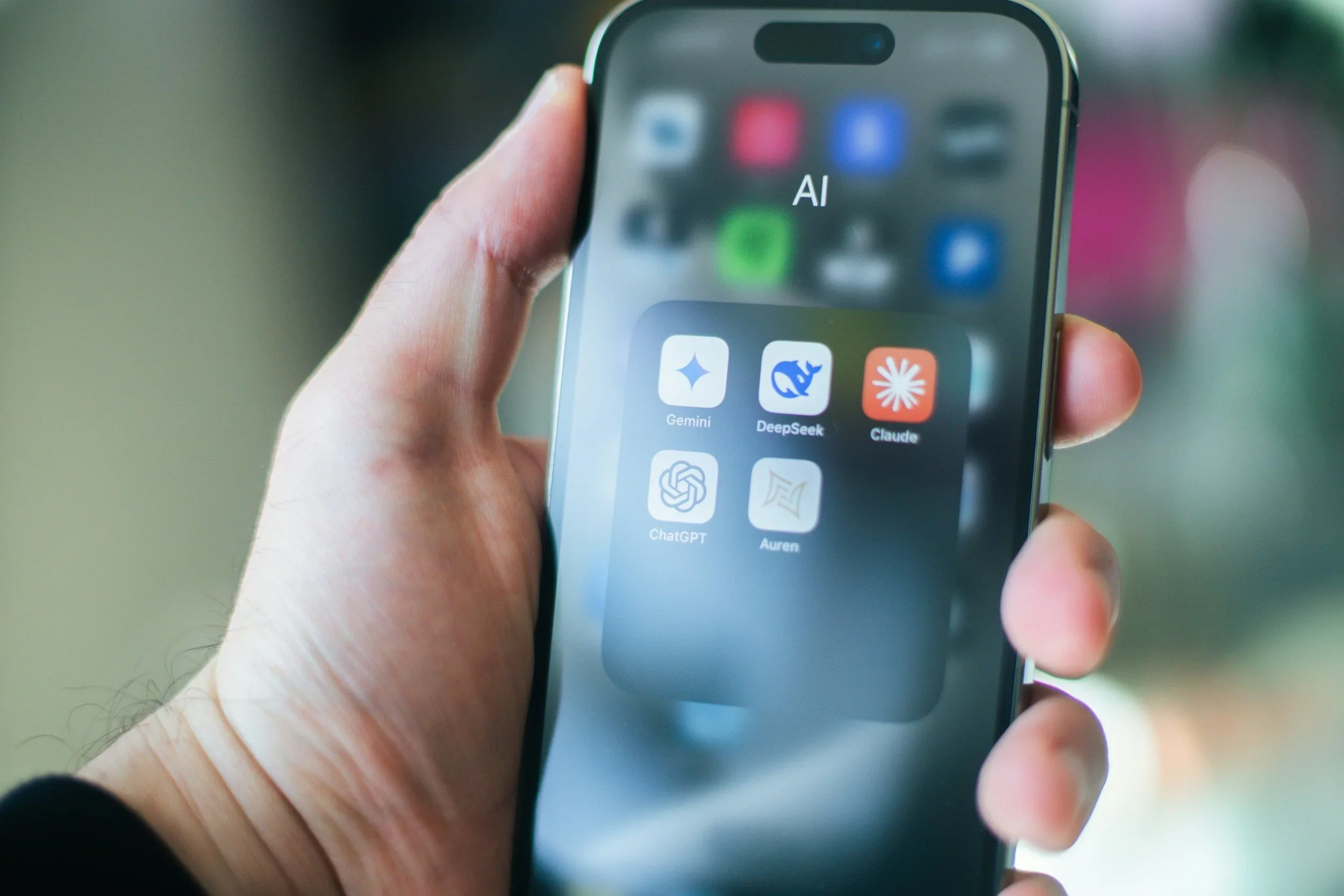
The Empathic Machine: What Your AI Therapist Can and Can't Do
AI tools are genuinely good at certain things that matter. They don't judge. They don't get tired. They don't bring their own bad day into the conversation. They can reflect your experience back to you in a way that helps you feel less alone with it and informed, and for many people that is meaningful, sometimes even revelatory. If you have spent your life feeling like your emotional experience was too much, too confusing, or too shameful to say out loud, finding something that receives it without flinching has real value.
But here is what is worth understanding about the limits
There is a good chance you have already done it. Typed something painful into an AI LLM at midnight. Described a hard conversation with your partner, a spiral of anxiety, a grief you couldn't quite name. And received something back that felt surprisingly helpful. Insightful. Validating while also softly challenging. Organized. Warm, even. And it was free or relatively low cost.
You are not wrong that something real happened there. The question worth asking is what, exactly.
AI tools are genuinely good at certain things that matter. They don't judge. They don't get tired. They don't bring their own bad day into the conversation. They can reflect your experience back to you in a way that helps you feel less alone with it and informed, and for many people that is meaningful, sometimes even revelatory. If you have spent your life feeling like your emotional experience was too much, too confusing, or too shameful to say out loud, finding something that receives it without flinching has real value.
But here is what is worth understanding about the limits, not to discourage you from using these tools, but to help you use them honestly.
Your nervous system is a social organ. It was not designed to regulate itself in isolation. It was designed to regulate in relationship with other nervous systems. When you feel genuinely safe with another person, something biological is happening: your heart rate shifts, your breathing changes, something in the quality of their voice and presence signals to your body that the threat is over. This is not a metaphor. It is physiology. And it happens between bodies, not between a body and a server.
The AI can say calming things. It cannot send the signal your nervous system is actually waiting for, because it has no nervous system of its own.
There is something deeper here too. The therapists and thinkers who have studied what actually changes people suggest that transformation tends to happen not when we feel perfectly understood, but when we encounter someone who is genuinely other than us. Someone who can be surprised by us, moved by us, occasionally wrong about us in ways that have to be repaired. Someone who is, in a word, real. Who has their own limitations, their own interior life, their own skin in the game.
The AI has no skin in the game. It cannot be changed by you. It cannot be hurt or delighted or caught off guard. Its patience is not patience in the human sense. It is architecture. And a relationship with no stakes on one side is a particular kind of companionship, useful in its own way, but not quite what the deepest part of you is looking for.
What the AI does well is help you find language for experience, organize your thinking, and lower the threshold for getting care. Think of it as a place to start. The work that changes the nervous system, the self, the patterns that have run longest and hardest, that work happens in the presence of another person who is also, in some meaningful sense, on the line.
If something in you already knew that, you were right.
Trauma Isn’t Intensity — It’s What the Nervous System Learns
When people hear the word trauma, they often picture something overwhelming: extreme fear, intense emotion, or a catastrophic event. And while trauma can involve intense experiences, defining it primarily by emotional intensity actually misses the heart of the matter. Trauma is not best understood as how big something felt — but as what the nervous system learned when survival was at stake.

When people hear the word trauma, they often picture something overwhelming: extreme fear, intense emotion, or a catastrophic event. And while trauma can involve intense experiences, defining it primarily by emotional intensity actually misses the heart of the matter. Trauma is not best understood as how big something felt — but as what the nervous system learned when survival was at stake.
From a nervous-system perspective, trauma begins with threat. When we perceive danger, the body mobilizes automatically to protect us through fight, flight, or freeze. This mobilization requires a rapid surge of energy — heart rate increases, muscles tense, attention narrows. This temporary dysregulation is not a problem; it is the body doing exactly what it is designed to do.
Under normal circumstances, that survival energy is spent. We run, resist, escape, or orient toward safety. Once the threat passes and the energy is discharged, the nervous system returns to its baseline rhythm of regulation and flexibility.
Trauma occurs when that process is interrupted.
When a threat cannot be escaped, fought, or fully responded to — because of powerlessness, overwhelm, developmental immaturity, or relational constraints — the nervous system is forced to cope rather than complete the survival cycle. The energy meant for action remains trapped in the body. This unresolved dysregulation is profoundly uncomfortable, and the system adapts in whatever way it can to endure.
Over time, this unfinished survival response becomes encoded as learning.
As Mark Solms explains in The Feeling Brain, affect is fundamentally tied to homeostasis — the body’s drive to regulate internal states. Trauma represents a disruption in this regulatory process. The system does not simply remember what happened; it remembers how it survived.
Similarly, Stephen Porges shows through Polyvagal Theory that our nervous systems continuously assess safety and danger beneath conscious awareness. When safety cannot be restored, the system defaults to defensive strategies — hyperarousal, collapse, shutdown — not as pathology, but as protection.
Crucially, the coping strategies used during the original threat often replace instinctive responses in the future. Instead of fluid fight or flight, the body replays learned patterns. This is why trauma can show up in two seemingly opposite ways: explosive emotional reactions that feel disproportionate to the present moment, or a puzzling absence of response when action would be appropriate. In both cases, the nervous system is responding to past threat in the present.
As Allan Schore emphasizes, trauma is ultimately a disorder of affect regulation. It is not the event itself that defines trauma, but whether the nervous system could return to regulated flow afterward — especially in the presence of attuned support.
Understanding trauma this way reframes healing. The work is not primarily about revisiting intense emotions or retelling the story in greater detail. It is about helping the nervous system complete what was once impossible: restoring regulation, releasing trapped survival energy, and relearning that safety and responsiveness are possible now.
Trauma is not intensity. It is unfinished survival — and the body remembering how it had to cope when there was no other choice.
Why Belonging belongs with DEI
Belonging is an important addition to Diversity Equity & Inclusion that impacts our nervous systems and helps DEI to achieve its goals. Find out how and why.
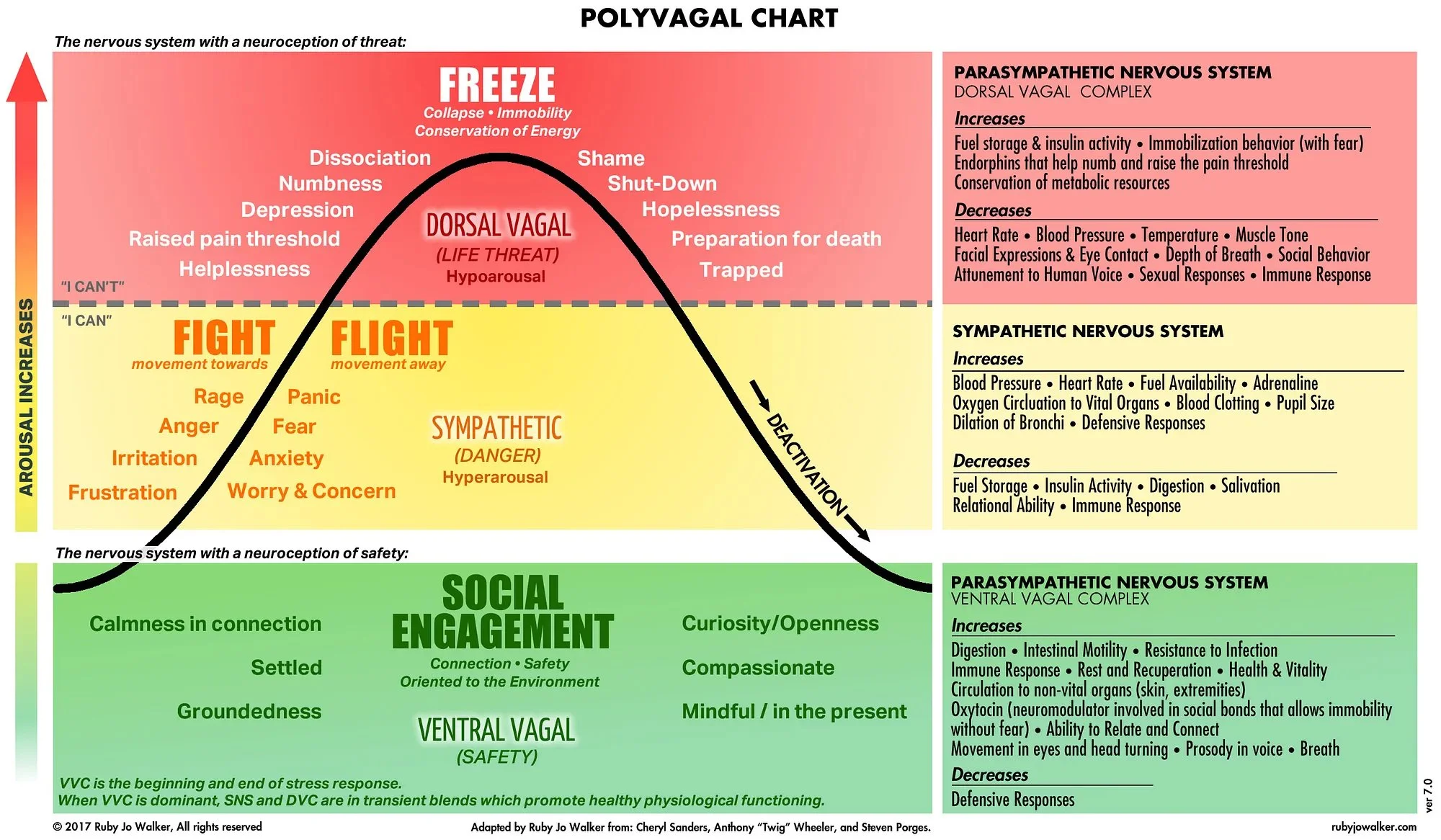
As you can see from the image above, the highest stress point causes freeze. Freeze happens on a spectrum. In the work place it might look more like going quiet in a meeting, not speaking up against a co-worker or supervisor who is being inappropriate, allowing others to take credit for one's own ideas or work, laughing and going along with things that make one feel sick inside, etc. Diversity helps us widen who is a part of the work place. This is a value to the company because it brings in more perspectives that will bring more collective wisdom. But because diversity can be limited by bias to certain categories (e.g. diversity in age but not in race, gender, etc.) Equity helps diversity stay accountable. Inclusion does the same for Equity by not only creating seats at the table for people but ensuring they have a voice. Belonging continues this trend of helping the previous letters meet their goals. With all of DEIB you are increasing psychological safety in the work place which helps people have a better chance of staying in the green of social engagement (this is good for creativity, problem solving and productivity) and out of the yellow of fight or flight and the red of freeze. Belonging brings this home by helping people feel that their inclusion is not a burden, that their personal experience is not alien or isolated but understood by the community of their workplace. Belonging helps people feel they fit. When people feel they fit they can naturally be authentic and have a voice easier. This is how Belonging helps Inclusion meet its goals and makes the green of social engagement even easier.
#DEI #DEIB #PsychologicalSafety #Polyvagal #Belonging