

What is somatic experiencing
Somatic Experiencing is a gentle, body-based trauma therapy that works with your nervous system. This pos is about what it looks like in session, and who it helps.

Somatic Experiencing® (SE™) is a gentle, body-focused approach to treating the effects of stress, shock, and trauma (Levine, 1997, 2010). It works by helping you complete the self-protective responses that got interrupted and stayed stuck in your body, and by discharging the energy that came with them (Payne, Levine, & Crane-Godreau, 2015). As that happens, the alarm signaling danger starts to turn off and your system can settle. Because the focus is on bodily sensation rather than only on thoughts and memories, SE offers a different route into healing from trauma and back toward a sense of well-being and connection to life.
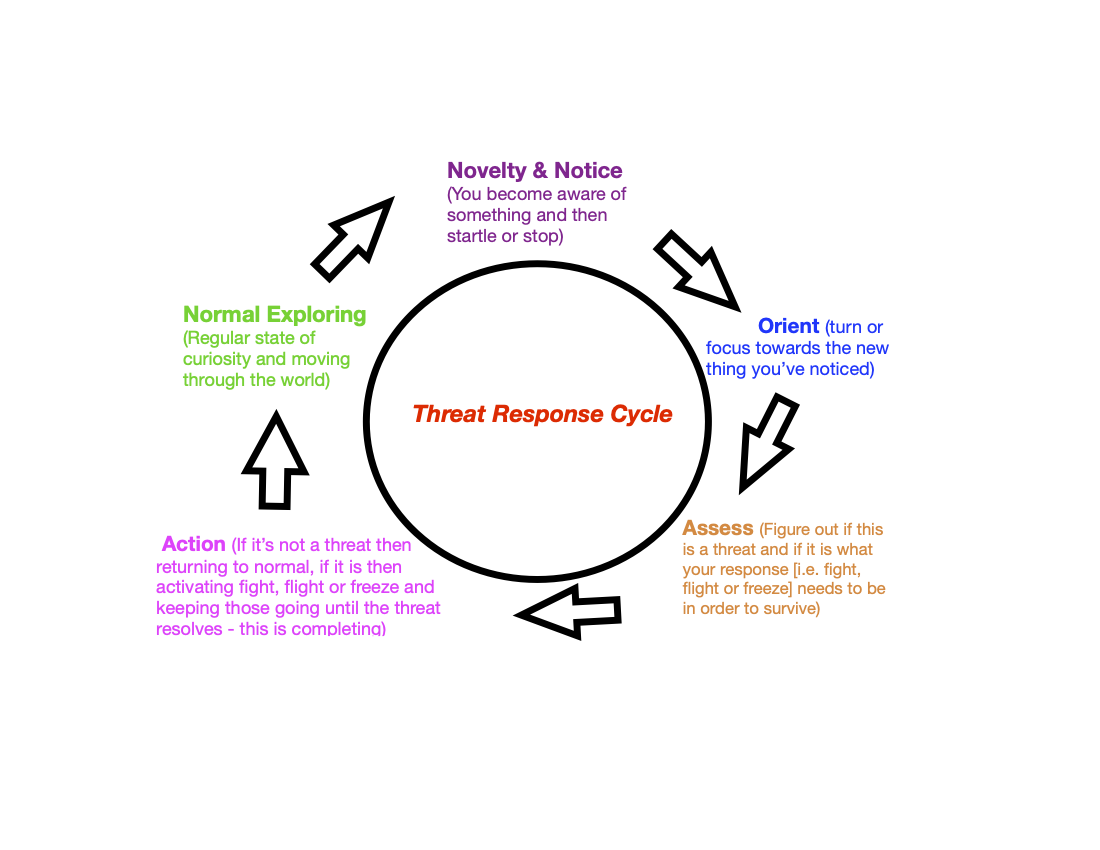
In practice, this means a practitioner teaches you skills and you practice them together in session. It usually starts with learning how to shift your focus. We come in focused on the pain, the problem, the tension or unconsciously avoiding the problem, pain and tension. But what happens when you take control of your attention? For example, what is it like when your attention is turned outward instead of inward feel like? The natural threat response cycle your biology already uses has a part called orienting. When you focus outward with your vision (an eye exercise called, no surprise, orienting) you engage that part of the cycle that signals to your system a sense of safety and gives your nervous system a break (Payne et al., 2015). Simple looking, but powerful when practiced regularly. Though if your system is cultivated to either shut down or blow up you might feel a lot of resistance to this as it is asking your system to do something different.
Then you might turn inward. What does activation feel like on the inside compared to deactivation? From there, with coaching, you learn to track your sensations and observe them in a way that lets the natural rhythm of your nervous system come back. Attention to internal sensation, both visceral and musculoskeletal, is the primary intervention in SE (Payne et al., 2015).
That can include quivering or shaking, either in session or later on. Sometimes when people experience the quivering they report feeling out of control, or scared that something is wrong with them. Nothing is wrong. Trembling is a normal part of sympathetic activation and the discharge that follows it (Payne et al., 2015). People also report shifts in digestion, with diarrhea starting or stopping. That is okay too. Your threat response system and your gut are in constant two-way communication (Mayer, 2011). Acute stress speeds up transit through the colon, which is where the diarrhea comes from, and at the same time slows the stomach's emptying (Taché & Bonaz, 2007). The deeper shutdown states that come with threat you cannot escape slow things down further still (Kozlowska, Walker, McLean, & Carrive, 2015).
There is more to it than that, but hopefully that sketches out the initial steps of how SE differs from traditional talk therapy. Yes, there is talking. There is also much more stopping, slowing down, taking cues from your nervous system, and being guided toward specific kinds of support for your body.
Another hallmark of SE is going slowly so the nervous system can avoid overwhelm. You feel a little, then back off. SE calls this titration, working drop by drop, paired with pendulation, the deliberate back and forth between activation and discharge (Payne et al., 2015). We will even interrupt a pre-conditioned pattern you may have of feeling something and flooding right away, so you can build new muscle for bite-sized portions of stress instead of all of it at once. That might look like me interrupting you and getting curious about what is happening on the inside, or asking you to stand up and move, or trying a regulation technique that runs through your body rather than your thinking.
Finally, there can be touch in SE. Fully trained practitioners have skills in using touch to aid the release of incomplete fight, flight, and freeze responses, and both practitioners and clients describe touch as one of the things that makes the work really effective (Kuhfuß, Maldei, Hetmanek, & Baumann, 2021). Touch is not where we start though. It comes later, after safety and connection are established, with your consent, and only when it is relevant to the work.
The Science Behind It
Now that I have described what it is, here is a little about why it is.
Trauma can come from intense stress, either from a single event or built up over time, and it disrupts our ability to live with ease and resilience. Accidents, surgeries, abuse, conflict, natural disasters. SE addresses these by working with the body's response to that stress.
SE's founder, Dr. Peter A. Levine, took his cue from how animals in the wild recover from life-threatening situations without carrying trauma forward. He noticed that animals naturally shake off the excess energy of the freeze response (Levine, 1997, 2010). SE applies that observation to humans, helping stuck energy move and release through a body-first approach to healing.
Like other mammals, we come with built-in protective responses to threat. We do not choose to feel threatened. It happens automatically and unconsciously, driven by instinct and long-term memory. Researchers describe these responses as a cascade: arousal, then fight or flight, then freezing, then tonic or collapsed immobility when the threat cannot be escaped, and finally a quiet recovery state (Kozlowska et al., 2015). To move through any of it, the body gathers energy, and gathering it creates dysregulation in our nervous and biological systems. That is supposed to be temporary. We spend the energy fighting, fleeing, or freezing, and the system re-regulates.
But often we cannot complete the response. We are at work, with our kids, in public, physically restrained. We cannot run, cannot let ourselves get that angry or that afraid, cannot shut down. The energy stays gathered and the dysregulation stays with it. Think of a wave that keeps building and never gets to break. Animals tend to return to baseline once the danger passes. People more often stay locked into the pattern that formed around the original event (Kozlowska et al., 2015). If that never gets tended to and completed, the dysregulation becomes the new baseline. The next time threat shows up, we are already starting from a more fragile place. If we do not complete that one either, it stacks. Over time we have less and less bandwidth for the ordinary stresses of life, and we usually start living in smaller and smaller ways. It can affect physical health too.
Who It Helps
SE is a holistic approach drawing on physiology, psychology, biology, neuroscience, and traditional healing practices. It can apply to many symptoms and needs. The bread and butter of it, though, is for people who have been through trauma: medical trauma, accidents, assaults, violence, trapped situations, and the like.
It also tends to help people who have already done a lot of talking about what happened and still feel it in their body. If you have told the story, understood the story, and your system still runs hot or still shuts down, that gap is what SE works with.
What the Research Says So Far
Somatic Experiencing is not considered a full evidenced based treatment (yet). The strongest study to date is a randomized controlled trial in which people with PTSD who received fifteen weekly SE sessions showed significant symptom reduction compared to a waitlist control group, with gains holding at follow-up (Brom et al., 2017). A later trial that added SE to physiotherapy for low back pain with post-traumatic stress symptoms found that both groups improved but that adding SE produced no additional benefit (Andersen, Ellegaard, Schiøttz-Christensen, Mejldal, & Manniche, 2020). A review of the literature concluded that the early results for PTSD symptoms are positive, and also that the evidence base is still small and does not yet meet the standards we would want for a well-established treatment (Kuhfuß et al., 2021).
So: promising, used widely, and still being studied. If you are considering this work, that is the honest picture. That said, anecdotally, solo or when paired with good psychotherapy or psychoanalysis I’ve seen SE to be life changing.
If you are wondering whether this is a fit, reach out. A first conversation is mostly about what you are carrying and what you want, and we go from there.
References
Andersen, T. E., Ellegaard, H., Schiøttz-Christensen, B., Mejldal, A., & Manniche, C. (2020). Somatic Experiencing® for patients with low back pain and comorbid posttraumatic stress symptoms: A randomised controlled trial. European Journal of Psychotraumatology, 11(1), 1797306. https://doi.org/10.1080/20008198.2020.1797306
Brom, D., Stokar, Y., Lawi, C., Nuriel-Porat, V., Ziv, Y., Lerner, K., & Ross, G. (2017). Somatic Experiencing for posttraumatic stress disorder: A randomized controlled outcome study. Journal of Traumatic Stress, 30(3), 304–312. https://doi.org/10.1002/jts.22189
Kozlowska, K., Walker, P., McLean, L., & Carrive, P. (2015). Fear and the defense cascade: Clinical implications and management. Harvard Review of Psychiatry, 23(4), 263–287. https://doi.org/10.1097/HRP.0000000000000065
Kuhfuß, M., Maldei, T., Hetmanek, A., & Baumann, N. (2021). Somatic experiencing: Effectiveness and key factors of a body-oriented trauma therapy: A scoping literature review. European Journal of Psychotraumatology, 12(1), 1929023. https://doi.org/10.1080/20008198.2021.1929023
Levine, P. A., with Frederick, A. (1997). Waking the tiger: Healing trauma. North Atlantic Books.
Levine, P. A. (2010). In an unspoken voice: How the body releases trauma and restores goodness. North Atlantic Books.
Mayer, E. A. (2011). Gut feelings: The emerging biology of gut-brain communication. Nature Reviews Neuroscience, 12(8), 453–466. https://doi.org/10.1038/nrn3071
Payne, P., Levine, P. A., & Crane-Godreau, M. A. (2015). Somatic experiencing: Using interoception and proprioception as core elements of trauma therapy. Frontiers in Psychology, 6, 93. https://doi.org/10.3389/fpsyg.2015.00093
Taché, Y., & Bonaz, B. (2007). Corticotropin-releasing factor receptors and stress-related alterations of gut motor function. The Journal of Clinical Investigation, 117(1), 33–40. https://doi.org/10.1172/JCI30085

Where Psychoanalysis and Somatic Experiencing Meet: The Brain's Threat Predictions
How psychoanalysis and Somatic Experiencing approach the same nervous system threat response through different doors, one relational, one somatic.

The overlap between psychoanalysis and Somatic Experiencing shows up most clearly in how each one understands threat.
Your brain is built to predict, not just to react. When pain leaves a strong enough mark, whether from a single intense event or a pattern repeated over time, the brain starts trying to see it coming. This is not a decision you make. It is an old, automatic, self-protective process that runs whether you want it to or not. You do not choose to feel threatened, and you do not choose which situations your nervous system flags as dangerous. Those calls get made below conscious awareness, based on everything that has happened to you before.
The trouble starts when those predictions stop matching the present. Instead of keeping you safe, they cause you to overreact to things that are not actually dangerous, or underreact to things that are. Either way, the pattern can replay old pain where it does not need to exist. For example, if you predict someone will hurt you, you might treat them as a threat before they've done anything. Eventually they react to being treated that way, maybe with frustration, maybe by pulling back, and that reaction feels like proof the original prediction was right. Nothing has changed. The pain has just been recreated. Good therapy retrains the unconscious prediction itself. It updates the nervous system so its forecasts match current reality, and it builds skills for managing threat responses in the meantime, so the automatic pattern has less room to keep firing while the deeper rewiring happens.
Psychoanalysis and Somatic Experiencing both spend their time watching for this same threat response. They just look for it in different places, and they call it by different names.
Psychoanalysis calls it a defense. A defense can show up as a feeling, a thought, a word, or an action. Its job is to help you feel calmer when an emotion is present that you cannot express, so instead of feeling the tension of that emotion directly, and the panic that expressing it might lead to pain, you distract yourself with something else. This happens outside conscious awareness. A defense is, by definition, an unconscious process. For example, say a patient feels something toward the therapist in session, anger, shame, sadness, lust, it does not matter which, and some part of them believes that expressing it directly will lead to pain: rejection, embarrassment, disapproval. The patient's nervous system and mind work to keep that feeling out of their awareness. Instead, they reflexively describe the same feeling as it shows up somewhere safer, a conflict at work, a frustration with a friend. Or they might bury it further, drifting into words that sound like the real subject without naming it, or a topic that sits just next to it without touching it. Sometimes the defense is even simpler: the patient draws a blank and says they have nothing to talk about. A trained analyst tracks not just what the patient says but how the patient relates to the analyst in the room (and how the analyst relates to the patient, but that is a different post altogether), and learns to hear these substitutions and absences as information, not as nothing happening.
Somatic Experiencing calls it a self-protective response. It is the same mechanism doing the same job, just visible in the body instead of in speech. Because the body reacts before language can filter it, interventions to the body work closer to the source. The problem is the same as in psychoanalysis: the emotions and the threat reaction are unconscious. A patient feeling something they cannot let themselves feel fully might look away, tighten their jaw, shift how they breathe, or move a leg. Underneath the visible signs are shifts that are harder to see from across the room: heart rate, sensation, digestion. Noticing them usually takes the clinician getting curious with the patient about what they are experiencing on the inside. An SE-trained clinician tracks these signals directly and helps the patient learn to notice them too, building new patterns in how the patient relates to themselves. That is what allows SE's interventions to help unresolved threat responses finally complete and settle instead of running on repeat.
So how does noticing a defense or a self-protective response actually change anything?
When a psychoanalyst notices a defense, a coded threat reaction, she often brings it into the room. The point is not to catch the patient out. It is to bring the emotion hiding inside the code, the Trojan horse feeling, into the light where it can be felt directly in the presence of another person. If that feeling can be felt in this new context without the pain the patient's brain predicted, rejection, disapproval, whatever the old prediction promised, the brain gets evidence that contradicts what it expected. That disconfirming experience is where new learning happens.
Somatic Experiencing works toward the same disconfirmation through the body. When a clinician notices a coded self-protective response, she brings it up with curiosity, then guides the patient through what it takes to let that same Trojan horse emotion finish what it started, physically. A trembling that never got to happen, a breath that got cut short, a movement the body prepared but never completed. Finishing it produces the same kind of disconfirming experience psychoanalysis is after, just reached through sensation instead of speech.
Either way, new learning creates new predictions. Enough of them, repeated enough times, and they stop requiring conscious effort. They become the new automatic, reflexive, unconscious patterns of feeling, thought, and behavior, the same way the old threat-based ones did. The difference is what they are built from. Patients who get there tend to describe the same thing on the other side of it: more freedom, more authenticity, more feeling alive in their own life.
Different entry points, same target. One reads the threat response through what a patient says, and does not say, in conversation. The other reads it through what a patient's body does without being asked. At Analog, we use both.
If this sounds simple, it is, on purpose, for the sake of a blog post. The actual process is tailored to each person and involves far more nuance and a far wider range of intervention than a few paragraphs can hold. Psychoanalysis and Somatic Experiencing are also not the same discipline. Each has real differences from the other that do not collapse into a shared metaphor. But what connects them outweighs what separates them, and therapy aimed at this kind of structural change, in either form, has the capacity to change a person's life for the better.

attachment Fireworks: Why holiday Gatherings can Turn Into Anger You Didn't See Coming
Holiday anger often isn't about anger. It's panic and grief in disguise. A look at attachment, RAGE, and how to work through it when tempers flare.

Holidays carry memories of both togetherness and loss. Today's holiday, the Fourth of July, can bring up either side of that. Family visits, cookouts, long weekends with the same handful of people from morning to night. Or the absence of those gatherings: kids grown and gone, family members who've passed, living somewhere else now, a fallout that never got resolved. Either one can stir up old attachment wounds. Old roles come back. Old sore spots get touched. Someone brings up something from years ago, or nobody brings it up and the silence says just as much. And often what shows up first isn't sadness or fear. Alongside the fireworks outside, there's a different kind of combustion happening inside. It's anger.
It's easy to misread aggression. By design, it triggers fight, flight, or freeze in whoever is on the receiving end. Those are self-preserving modes, and in them it's nearly impossible to stay mindful or to do what Peter Fonagy calls mentalizing: accurately tracking what you think and feel, and what the other person thinks and feels, at the same time. Whether the anger is coming from someone else or from us, it's hard to tell in the moment whether the anger is really about anger, or whether it's covering something more vulnerable underneath.
This is especially true when anger is standing in for panic, and underneath that, grief.
The system underneath the anger
Attachment distress and attachment security are rooted in a brain system Jaak Panksepp called PANIC/GRIEF, working alongside two other systems called CARE and SEEKING. When disconnection happens and you need connection back, the automatic reaction is panic. That panic exists to alert you, and the people around you, that you need connection for survival. It teams up with SEEKING to point you toward the person you need. When that person notices your panic, it's their own CARE and SEEKING systems that pull them back toward you. These are old, fast circuits, and they run well beneath conscious thought.
When panic doesn't succeed in getting reconnection (through neglect or through attack) it risks tipping into the pain of isolation and grief. That's a state where you feel helpless, alone, and often like you don't matter. It can feel close enough to a threat to survival that the FEAR system recruits its counterpart, RAGE, to pull the system out of that collapse. RAGE brings a stronger, more mobilized feeling than panic or grief, and for a nervous system that's starting to feel it might not survive disconnection, that mobilization can feel like relief.
Why anger works, until it doesn't
Anger is empowering. Its original job, as Paul Ekman and Silvan Tomkins both described, is to clear whatever stands between you and something you're after. It comes with a sense of rightness and a jolt of confidence. Paired with SEEKING, it can help a person get real things done.
The problem is that in relationships, when anger is being called up in service of PANIC/GRIEF rather than in service of an actual obstacle, it tends to produce the opposite of what's needed. It pushes the other person away and adds to the misunderstanding instead of resolving it. The person on the receiving end usually focuses on the anger itself and misses the panic, grief, and fear driving it. That deepens the isolation, the helplessness, and the hit to self-worth that started the whole cycle.
From response to pattern
This pattern doesn't come from nowhere. It builds out of repeated experiences where attachment cues weren't met well, and over time the response becomes automatic. At the automatic, repeated level, we start calling it personality.
This particular pattern (anger that is really panic and grief in disguise) shows up more often in certain personality profiles: Borderline Personality Disorder, Narcissistic Personality Disorder, and in Enneagram terms, the one-to-one (sexual) subtypes of Eights, Ones, and Fours in particular. In each case, the anger looks like the presenting problem, but the attachment system underneath it is what actually needs attention.
What changes it
Change comes from three places: awareness, tools, and new experience.
Awareness means being able to mindfully notice when you're about to tip into this state, when you're in it, and what happened as a result once it's passed. That includes recognizing your own patterns: how you think, what you feel, where your eyes go, what happens in your body, how you move, and what you tend to say. A simple way to check yourself, or to notice it in someone else, is to ask what you tend to:
Think
Say
Feel
Do
Tools, from a Somatic Experiencing lens, give the nervous system a way to move through activation instead of getting stuck at the top of it or freezing under it.
Titration means taking the activation in small pieces instead of all at once. Rather than diving straight into the memory or the argument that set off the rage, you touch it briefly, notice what happens in the body, and back off before it overwhelms you. Small doses are easier for the nervous system to process and complete.
Pendulation is the rhythm of moving between that activation and a place of relative ease or resource, back and forth. You might notice the heat rising in your chest, then shift attention to your feet on the floor or a steady breath, then check back in with the heat. That back and forth is what teaches the body it can go into activation and come back out, instead of getting flooded.
Shifting attention in and out works alongside both. Attention in means noticing sensation, tension, temperature, and impulses to move. Attention out means noticing the room, another person's face, or something neutral and steady nearby. Moving between the two keeps you from getting swallowed by the internal experience or dissociating away from it entirely.
Tracking waves of activation and deactivation means watching the rise and fall as it happens rather than judging it. Rage has a shape: it builds, it peaks, and if you don't feed it or fight it, it comes back down. Learning to watch that curve, rather than either suppressing it or getting swept into it, is what turns rage from something that happens to you into something you can move through.
None of this is about stopping the anger before it starts. It's about staying present enough in your body to ride the wave instead of being ridden by it.
New experience comes from two places at once: growing confidence in your own capacity for self-regulation, and being met by people whose own nervous systems can stay regulated while yours isn't, people who can understand you and stay close to you through the storm instead of matching it or retreating from it.
Bringing it back to the holiday
If this weekend brings up a flash of irritation at a family member that threatens to turn into a blow up or painful drama, or you watch someone you love go from calm to furious over something small, try not to jump straight to conclusions about "bad behavior." Underneath a lot of holiday tempers is an old, fast circuit doing exactly what it was built to do: trying to get connection back before the isolation underneath becomes unbearable.
That doesn't excuse harm done in the heat of it. But it does point to where the real work is. Not in suppressing the anger and not in venting it, but in learning to recognize the panic and grief driving it, and building the capacity, in yourself and in your relationships, to stay close through the storm instead of being scattered by it.

Your Eyes Are Talking to Your Nervous System
Most people think about their eyes as the tools they use to see. What they don’t usually think about is that their eyes are part of their brain. Literally. In utero, the eyes separate from the same brain tissue that becomes everything else. The connection never goes away.

Most people think about their eyes as the tools they use to see. What they don’t usually think about is that their eyes are part of their brain. Literally. In utero, the eyes separate from the same brain tissue that becomes everything else. The connection never goes away.
My friend and colleague, Lillian Giocondo, turned me on to following the Biology of Trauma podcast, and a recent episode with neuro-optometrist Dr. Bryce Appelbaum grabbed my attention. Not because the information was fringe or surprising exactly, but because it put language to something we work with in Somatic Experiencing all the time.
In SE, we pay a lot of attention to the eyes.
We’ll sometimes ask a client to let their gaze soften. To notice what’s in their peripheral field without turning their head. To slowly move their eyes in different directions and notice what happens in the body. Or even to track our fingers and notice when the eye sight glitches. These aren’t quirky add-ons to the work. They’re rooted in the same biology Dr. Appelbaum describes.
Two-thirds of the neurons entering the brain come through the eyes. That’s not a small number. Your nervous system is constantly reading visual input to decide whether you’re safe or in danger. And one of the clearest signals it looks for is whether your peripheral vision is open.
When the nervous system shifts into fight or flight, peripheral vision collapses. The world narrows. You stop seeing what’s beside you and start locking onto what’s in front of you. This is your threat response working exactly as designed. The problem is that for many people who carry stored trauma or chronic stress, that narrowing becomes the default. The tunnel becomes baseline.
Dr. Appelbaum describes this as the body adapting to a tunneled state. The brain stops expecting wide vision. It reorganizes. And over time, people describe feeling like they’re looking through paper towel rolls. Which is just their eyes staying in a survival state.
In SE, one type of eye work we do is called, “orienting.” When a client can slowly, voluntarily move their eyes around the room and allow their eyes stop and focus on what they see, that’s the nervous system checking in with reality and finding it safe. The body follows. Shoulders often drop. Breath often comes in a little more easily.
Dr. Appelbaum introduces three simple exercises in the episode: peripheral pointing, eye push-ups, and eye stretches. Peripheral pointing involves fixing your gaze on a point in the room and then noticing, without moving your eyes, what else is out there. Pointing to it. Then checking. It rebuilds the body’s sense of being in space rather than locked into a single threat point.
These exercises build the same capacity we’re reaching for in SE. The ability to be in a body that can take in more of the world, to have more capacity not just tolerance. A nervous system that isn’t white-knuckling.
If you’ve ever wondered why we slow things down in trauma therapy, why we ask what you notice in your body or what catches your eye in the room, or to stop and feel into your eyes, this episode offers one clear answer. The eyes are not passive recorders. They’re active participants in whether you feel okay right now.
Understanding Your Body's Alert System: A Guide to Feeling Safer in Everyday Life
Ever notice how your body reacts when you open a stressful email or get into an argument? That racing heart, those tense shoulders - these aren't random reactions. They're part of your body's natural alert system called the threat response cycle, and understanding this system can change your life in wonderful ways.
Ever notice how your body reacts when you open a stressful email or get into an argument? That racing heart, those tense shoulders - these aren't random reactions. They're part of your body's natural alert system called the threat response cycle, and understanding this system can change your life in wonderful ways.
Your Built-In Safety System
Think of your body as having a special safety alarm, an instinct for safety. Just like our ancestors needed this alarm to stay safe from wild animals, we use it today in our modern world. This system kicks in when:
Reading a difficult email
Sitting through a tense meeting
Having a disagreement with someone you love
Walking into a crowded restaurant
Even chatting with a friend when a sensitive topic comes up
The Threat Response Cycle
Why Understanding This Matters
When you know how your alert system works, you gain a superpower: the ability to pause and check if you really need to be on high alert. Sometimes your alarm might go off when you're actually safe, like feeling panicked about giving a presentation to friendly colleagues. Other times, you might not notice real warning signs when you should, like staying in an unhealthy situation for too long.
Taking Back Control
The good news? Once you recognize when your alert system is active, you can:
Take a moment to pause
Look around and check if there's a real reason for concern
Choose how to respond rather than just react
Return to feeling calm and present when you realize you're safe
This awareness helps you move through your day with more peace and confidence. Instead of being controlled by automatic reactions, you can choose how to respond to life's challenges.
Remember: Your alert system isn't your enemy - it's trying to protect you! Learning to work with it, rather than against it, can help you feel more in control and at peace in your daily life.