

attachment Fireworks: Why holiday Gatherings can Turn Into Anger You Didn't See Coming
Holiday anger often isn't about anger. It's panic and grief in disguise. A look at attachment, RAGE, and how to work through it when tempers flare.

Holidays carry memories of both togetherness and loss. Today's holiday, the Fourth of July, can bring up either side of that. Family visits, cookouts, long weekends with the same handful of people from morning to night. Or the absence of those gatherings: kids grown and gone, family members who've passed, living somewhere else now, a fallout that never got resolved. Either one can stir up old attachment wounds. Old roles come back. Old sore spots get touched. Someone brings up something from years ago, or nobody brings it up and the silence says just as much. And often what shows up first isn't sadness or fear. Alongside the fireworks outside, there's a different kind of combustion happening inside. It's anger.
It's easy to misread aggression. By design, it triggers fight, flight, or freeze in whoever is on the receiving end. Those are self-preserving modes, and in them it's nearly impossible to stay mindful or to do what Peter Fonagy calls mentalizing: accurately tracking what you think and feel, and what the other person thinks and feels, at the same time. Whether the anger is coming from someone else or from us, it's hard to tell in the moment whether the anger is really about anger, or whether it's covering something more vulnerable underneath.
This is especially true when anger is standing in for panic, and underneath that, grief.
The system underneath the anger
Attachment distress and attachment security are rooted in a brain system Jaak Panksepp called PANIC/GRIEF, working alongside two other systems called CARE and SEEKING. When disconnection happens and you need connection back, the automatic reaction is panic. That panic exists to alert you, and the people around you, that you need connection for survival. It teams up with SEEKING to point you toward the person you need. When that person notices your panic, it's their own CARE and SEEKING systems that pull them back toward you. These are old, fast circuits, and they run well beneath conscious thought.
When panic doesn't succeed in getting reconnection (through neglect or through attack) it risks tipping into the pain of isolation and grief. That's a state where you feel helpless, alone, and often like you don't matter. It can feel close enough to a threat to survival that the FEAR system recruits its counterpart, RAGE, to pull the system out of that collapse. RAGE brings a stronger, more mobilized feeling than panic or grief, and for a nervous system that's starting to feel it might not survive disconnection, that mobilization can feel like relief.
Why anger works, until it doesn't
Anger is empowering. Its original job, as Paul Ekman and Silvan Tomkins both described, is to clear whatever stands between you and something you're after. It comes with a sense of rightness and a jolt of confidence. Paired with SEEKING, it can help a person get real things done.
The problem is that in relationships, when anger is being called up in service of PANIC/GRIEF rather than in service of an actual obstacle, it tends to produce the opposite of what's needed. It pushes the other person away and adds to the misunderstanding instead of resolving it. The person on the receiving end usually focuses on the anger itself and misses the panic, grief, and fear driving it. That deepens the isolation, the helplessness, and the hit to self-worth that started the whole cycle.
From response to pattern
This pattern doesn't come from nowhere. It builds out of repeated experiences where attachment cues weren't met well, and over time the response becomes automatic. At the automatic, repeated level, we start calling it personality.
This particular pattern (anger that is really panic and grief in disguise) shows up more often in certain personality profiles: Borderline Personality Disorder, Narcissistic Personality Disorder, and in Enneagram terms, the one-to-one (sexual) subtypes of Eights, Ones, and Fours in particular. In each case, the anger looks like the presenting problem, but the attachment system underneath it is what actually needs attention.
What changes it
Change comes from three places: awareness, tools, and new experience.
Awareness means being able to mindfully notice when you're about to tip into this state, when you're in it, and what happened as a result once it's passed. That includes recognizing your own patterns: how you think, what you feel, where your eyes go, what happens in your body, how you move, and what you tend to say. A simple way to check yourself, or to notice it in someone else, is to ask what you tend to:
Think
Say
Feel
Do
Tools, from a Somatic Experiencing lens, give the nervous system a way to move through activation instead of getting stuck at the top of it or freezing under it.
Titration means taking the activation in small pieces instead of all at once. Rather than diving straight into the memory or the argument that set off the rage, you touch it briefly, notice what happens in the body, and back off before it overwhelms you. Small doses are easier for the nervous system to process and complete.
Pendulation is the rhythm of moving between that activation and a place of relative ease or resource, back and forth. You might notice the heat rising in your chest, then shift attention to your feet on the floor or a steady breath, then check back in with the heat. That back and forth is what teaches the body it can go into activation and come back out, instead of getting flooded.
Shifting attention in and out works alongside both. Attention in means noticing sensation, tension, temperature, and impulses to move. Attention out means noticing the room, another person's face, or something neutral and steady nearby. Moving between the two keeps you from getting swallowed by the internal experience or dissociating away from it entirely.
Tracking waves of activation and deactivation means watching the rise and fall as it happens rather than judging it. Rage has a shape: it builds, it peaks, and if you don't feed it or fight it, it comes back down. Learning to watch that curve, rather than either suppressing it or getting swept into it, is what turns rage from something that happens to you into something you can move through.
None of this is about stopping the anger before it starts. It's about staying present enough in your body to ride the wave instead of being ridden by it.
New experience comes from two places at once: growing confidence in your own capacity for self-regulation, and being met by people whose own nervous systems can stay regulated while yours isn't, people who can understand you and stay close to you through the storm instead of matching it or retreating from it.
Bringing it back to the holiday
If this weekend brings up a flash of irritation at a family member that threatens to turn into a blow up or painful drama, or you watch someone you love go from calm to furious over something small, try not to jump straight to conclusions about "bad behavior." Underneath a lot of holiday tempers is an old, fast circuit doing exactly what it was built to do: trying to get connection back before the isolation underneath becomes unbearable.
That doesn't excuse harm done in the heat of it. But it does point to where the real work is. Not in suppressing the anger and not in venting it, but in learning to recognize the panic and grief driving it, and building the capacity, in yourself and in your relationships, to stay close through the storm instead of being scattered by it.
Implicit Memory, Attachment Trauma, and the “Overreaction” That Isn’t
Sometimes a small piece of news hits your nervous system like a freight train. An unexpected post. A colleague changes plans. A friend forgets to respond. A partner sounds distracted. Suddenly your stomach knots, your breath shortens, your throat tightens, and tears hover. A part of you knows the situation doesn’t warrant this level of distress — but it still arrives in full force.
This moment is not weakness or irrationality. It’s implicit memory.

Sometimes a small piece of news hits your nervous system like a freight train. An unexpected post. A colleague changes plans. A friend forgets to respond. A partner sounds distracted. Suddenly your stomach knots, your breath shortens, your throat tightens, and tears hover. A part of you knows the situation doesn’t warrant this level of distress — but it still arrives in full force.
This isn’t irrationality or emotional fragility. For many people in Kansas City seeking therapy for relational patterns, it’s often implicit memory and attachment trauma showing up in the nervous system.
Implicit Memory and Attachment Trauma in Adulthood
Implicit memory is a body-based memory system that develops before language (Schore, 2003). It stores early attachment experiences as sensations, emotions, and autonomic states rather than stories. When early needs were unseen or inconsistently met, the nervous system learned to predict disconnection and prepare for loss.
In adult relationships, small signals can activate these predictions quickly. Shame often arrives in the body before the mind can explain it. Shame’s physical signatures — collapse, tightness, downward gaze, heat in the face, inhibited breath — are part of a freeze/appease response aimed at preserving connection (Porges, 2011; Gilbert, 2007).
Internal Working Models and Insecure Attachment
John Bowlby called the mental templates formed through early patterns Internal Working Models. These models guide expectations such as:
Are people available when I need them?
Am I safe in relationships?
Am I worthy of care and belonging?
For people with insecure attachment, minor relational cues today can activate the working models of yesterday. What looks like an “overreaction” is often a proportionate response to an old threat stored in the nervous system.
Fight, Flight, Freeze, or Fawn in Kansas City Therapy Clients
The nervous system organizes survival responses through fight, flight, freeze, and fawn (Levine, 2010). A snub may evoke fight (“How could you?”), flight (“I should just leave”), freeze (“I don’t know what to say”), or fawn (“I’ll fix it so they don’t get upset”). These strategies once protected attachment bonds.
Recognizing Implicit Memory in Real Time
A helpful marker is mismatch: your internal reaction feels much bigger (or smaller) than the situation. That’s often implicit memory activating.
Many Kansas City trauma-informed therapists use bottom-up approaches to help the nervous system update old attachment predictions, including Somatic Experiencing, nervous system tracking, and shame awareness work.
These approaches involve:
orienting to the environment
tracking body sensation
allowing affect (tears, yawns, trembling)
completing autonomic cycles
This helps the body metabolize what once had no support (Levine, 2010; Siegel, 2020).
The goal isn’t to erase early models, but to update them. When implicit memory becomes explicit — when one can say, “my body thinks I’m alone again” — new relational options emerge.
For Kansas City Readers
If you grew up with emotional neglect, inconsistent caregiving, or insecure attachment dynamics, these patterns are common and treatable. Trauma-informed counseling in Kansas City, Overland Park, and Johnson County can help update attachment predictions, reduce shame-driven responses, and build secure relational capacity.
Click here to schedule a free consult or your first appointment today.
References
Bowlby, J. (1969). Attachment and Loss.
Gilbert, P. (2007). The Compassionate Mind.
Levine, P. (2010). In an Unspoken Voice.
Porges, S. (2011). The Polyvagal Theory.
Schore, A. (2003). Affect Regulation and the Repair of the Self.
Siegel, D. (2020). The Developing Mind.
Understanding Your Body's Alert System: A Guide to Feeling Safer in Everyday Life
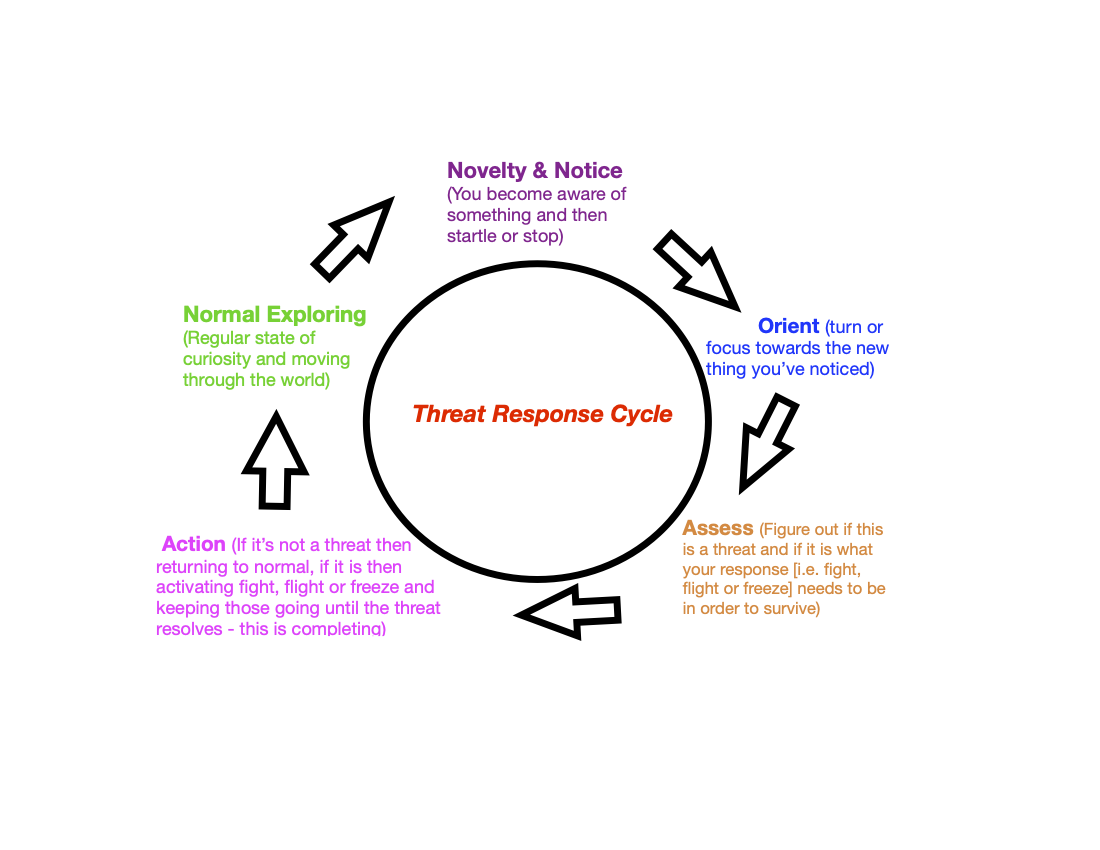
Ever notice how your body reacts when you open a stressful email or get into an argument? That racing heart, those tense shoulders - these aren't random reactions. They're part of your body's natural alert system called the threat response cycle, and understanding this system can change your life in wonderful ways.
Ever notice how your body reacts when you open a stressful email or get into an argument? That racing heart, those tense shoulders - these aren't random reactions. They're part of your body's natural alert system called the threat response cycle, and understanding this system can change your life in wonderful ways.
Your Built-In Safety System
Think of your body as having a special safety alarm, an instinct for safety. Just like our ancestors needed this alarm to stay safe from wild animals, we use it today in our modern world. This system kicks in when:
Reading a difficult email
Sitting through a tense meeting
Having a disagreement with someone you love
Walking into a crowded restaurant
Even chatting with a friend when a sensitive topic comes up
The Threat Response Cycle
Why Understanding This Matters
When you know how your alert system works, you gain a superpower: the ability to pause and check if you really need to be on high alert. Sometimes your alarm might go off when you're actually safe, like feeling panicked about giving a presentation to friendly colleagues. Other times, you might not notice real warning signs when you should, like staying in an unhealthy situation for too long.
Taking Back Control
The good news? Once you recognize when your alert system is active, you can:
Take a moment to pause
Look around and check if there's a real reason for concern
Choose how to respond rather than just react
Return to feeling calm and present when you realize you're safe
This awareness helps you move through your day with more peace and confidence. Instead of being controlled by automatic reactions, you can choose how to respond to life's challenges.
Remember: Your alert system isn't your enemy - it's trying to protect you! Learning to work with it, rather than against it, can help you feel more in control and at peace in your daily life.