
Supporting a Loved One Through a Panic Attack: A Resource for Family Members, etc.
Panic attacks are overwhelming surges of fear or distress, often accompanied by racing heart, shallow breathing, dizziness, and the intense feeling that something terrible is about to happen. Though they are not physically dangerous, they are emotionally intense and deeply unsettling to witness or experience.

In the previous post, I wrote about how to survive a panic attack. In this post, we’ll explore how to support our loved ones when they are suffering panic.
Panic Attacks Are Not Just "All in Their Head"
Panic attacks are overwhelming surges of fear or distress, often accompanied by racing heart, shallow breathing, dizziness, and the intense feeling that something terrible is about to happen. Though they are not physically dangerous, they are emotionally intense and deeply unsettling to witness or experience.
Key insight: Panic is often rooted in attachment distress — a reaction in the brain's emotional systems that signals threat, disconnection, or vulnerability. Neuroscientist Jaak Panksepp identified PANIC/GRIEF as one of the brain’s core emotional systems — the same system activated during separation, loss, or loneliness.
What Panic Attacks Feel Like to the Person Experiencing One:
“I think I’m dying.”
“I feel like I can’t breathe.”
“I’m going crazy.”
“I have to get out of here.”
These thoughts are often not rational — they are physiological reactions.
What Family Members May Feel:
Helpless
Anxious or panicked themselves
Frustrated or confused
Unsure what to do or say
Important: The more confident and calm you can stay, the more their nervous system can begin to settle.
How to Help During a Panic Attack
DO:
Speak gently and slowly. Try: “You’re safe right now. I’m here.”
Guide them to breathe slowly (match your breath with theirs if they can’t follow commands).
Help them orient: “Can you look around and name 5 things you see?”
Offer presence, not solutions (don’t ask a bunch of questions): Sit beside them, be steady.
Use their name. If appropriate, offer a hug, or touch their shoulder or hand gently (only if welcomed).
Afterward, offer water or something grounding (a cool cloth, weighted blanket, or walk).
DON’T:
Say “calm down” or “you’re overreacting.”
Ask them to explain or justify their feelings.
Leave unless they ask for space and are safe.
Understanding the Emotions Behind Panic: The Change Triangle (from the work of Hilary Jacobs Hendel)
The Change Triangle shows how we often move from core emotions (like fear, sadness, anger, joy) → to anxiety or panic → and then to defenses (like shutting down, lashing out, numbing). Panic attacks may appear out of nowhere, but they are often a signal that unprocessed core emotions have built up or been avoided.
Helping someone move from panic toward core emotion (like grief or fear) and then to connection or relief takes time, presence, and a calm environment.
You Are Not Their Therapist — But You Are Their Anchor
Your role is not to fix or diagnose. Your role is to be a safe attachment figure — someone whose presence says: “You are not alone in this.”
Think of yourself as a calm dock as they ride out a storm. You don’t have to stop the storm. Just stay close.
Helping Yourself While Helping Them
Take a deep breath yourself.
Remind yourself: “This is hard, but I can stay with it.”
Reach out to your own support system if needed.
Reflect on what you need afterward (rest, time alone, reassurance).
Repeat This to Yourself:
“This is not forever. This is a nervous system in distress. My steady presence helps.”
How to survive a panic attack
Many people have panic attacks or panic episodes. Panic might be one of the most misunderstood experiences in mental health. This is because many people don’t understand where panic is rooted in the brain and what that brain placement means. In the next post I will write about the meaning of panic attacks and how to support a loved one in a panic attack. For this post, here are immediate techniques you can try.

Many people have panic attacks or panic episodes. Panic might be one of the most misunderstood experiences in mental health. This is because many people don’t understand where panic is rooted in the brain and what that brain placement means. In the next post I will write about the meaning of panic attacks and how to support a loved one in a panic attack. For this post, here are immediate techniques you can try.
IMMEDIATE PANIC ATTACK TECHNIQUES
(Fast-acting methods to reduce panic and re-regulate)
1. Physiological Sigh (double inhale)
How to do it:
Inhale once through the nose
Take a second quick inhale on top
Exhale slowly and fully through the mouth
→ Repeat 1–3 times
Why it works:
Rapidly reduces CO₂ and calms the autonomic nervous system by engaging the parasympathetic “brake.”
Source: Huberman Lab, Stanford Neuroscience; Zelano et al., 2016
2. Orienting (Somatic Experiencing®)
How to do it:
Let your eyes slowly scan the environment
Notice colors, shapes, light, or movement
Gently turn your head as you do this
Let your body follow what feels interesting or settling
If rocking or swaying or other movement is spontaneous during this that’s fine too
Say to yourself:
“I’m here. I can look around. There’s no immediate danger.”
Why it works:
Engages the superior colliculus and ventral vagal system (Polyvagal Theory), signaling to the brain that you are safe.
Source: Peter Levine, SE International; Porges, 2011
3. 5-4-3-2-1 Grounding
How to do it:
5 things you see
4 things you can touch
3 things you hear
2 things you smell
1 thing you taste
Why: Brings you back to the present moment using sensory input, diverting focus from fear cycles.
Used widely in trauma-informed CBT and DBT
4. Box Breathing
How to do it:
Inhale – Hold – Exhale – Hold (4 seconds each)
→ Repeat 4–6 times
Why: Regulates breath rhythms and stimulates vagus nerve, reducing physiological arousal.
Navy SEALs, mindfulness protocols, HRV research
5. Cold Water or Ice Hack
How to do it:
Splash cold water on face or hold ice to palms or neck.
Why: Triggers the mammalian dive reflex, slowing heart rate and bringing attention back to the body.
Clinical anxiety relief; parasympathetic activation
6. “Feel Your Feet” Grounding
Press feet firmly into floor.
Wiggle toes, shift weight, sense contact.
Say: “These are my feet. The floor is holding me.”
Why: Activates proprioception, helps shift out of freeze or dissociation.
Somatic Experiencing®, Polyvagal Theory
7. “Name It to Tame It”
Say: “This is a panic attack. It will pass. I am safe even though it feels scary.”
Why: Puts language to emotion, engaging the prefrontal cortex to regulate the limbic system (amygdala).
Dan Siegel, “The Whole-Brain Child”
Why You Keep Reacting Like That: How Memory and Emotion Get Stuck—and How to Heal
Have you ever found yourself overreacting to something small, only to realize later that it reminded you of something bigger, something painful? You're not alone. There’s a reason for this—one that neuroscience and somatic therapy help us understand deeply.

Have you ever found yourself overreacting to something small, only to realize later that it reminded you of something bigger, something painful? You're not alone. There’s a reason for this—one that neuroscience and somatic therapy help us understand deeply.
Your Brain is a Prediction Machine
Your brain is always trying to help you survive. One of the ways it does this is by using the past to predict the future. This is efficient: instead of evaluating every situation from scratch, your brain compares new experiences to old ones to figure out what to do next. This is the core of how memory works.
As neuropsychologist Mark Solms explains, the brain is organized around affective (emotional) needs, and it constantly builds mental maps to keep us safe and satisfied. In this way, memory becomes a survival tool. [Solms, The Hidden Spring, 2021]
The Problem with Trauma
But here's the issue. Not all memories are accurate or helpful. When you go through a trauma—defined not by what happened, but by your nervous system’s inability to return to balance afterward—your brain records not just the event, but the emergency coping strategies you used in the moment.
Instead of remembering a completed emotional response (like a full cry or a protective act), your nervous system may remember a stuck state—fight, flight, or freeze energy that never got to finish. According to Peter Levine, this is the hallmark of trauma: incomplete survival responses held in the body. [Levine, Waking the Tiger, 1997]
So when something in the present even vaguely resembles that traumatic past, your brain says, “I’ve seen this before—danger!” and launches the same coping pattern, even if it’s not actually needed.
How Emotion Shapes Memory
Jaak Panksepp, a pioneer in affective neuroscience, identified core emotional systems in the brain that are shared across mammals, such as FEAR, SEEKING, RAGE, and CARE. These are deeply embodied—not just ideas in your head, but powerful forces in your nervous system. [Panksepp, The Archaeology of Mind, 2012]
When trauma distorts how these emotional systems operate, it can cause you to misinterpret present situations through the lens of old pain. You might withdraw in fear during a conflict, lash out in frustration, or numb out altogether—not because of what's happening now, but because of what your body remembers.
So How Do You Change This?
Healing involves interrupting that old survival loop. Here’s how to start:
Notice what happens in your body, emotions, impulses, and thoughts when you’re triggered. This builds awareness.
Support your nervous system with tools that create safety—slowing your breath, grounding yourself, using soothing touch or movement.
Work with your body to help it finish incomplete survival responses—shaking, crying, pushing, or other instinctive actions.
Let the emotions express. When you feel safe enough, those stuck feelings can finally move and release.
Reflect gently. Ask what meaning you attached to the event—were you unsafe, unloved, powerless? Are those meanings still true today?
Revisit the present moment and see it with fresh eyes. Is this current situation truly dangerous, or is it echoing something old?
This process doesn’t usually happen all at once. It’s slow, layered, and best done in the safety of a therapy relationship. Somatic Experiencing, developed by Peter Levine, is specifically designed to help you do this in a regulated, embodied way. With the presence of a therapist, your nervous system can borrow calm from theirs—a process known as co-regulation.
Sources:
Levine, P. A. (1997). Waking the Tiger: Healing Trauma.
Panksepp, J., & Biven, L. (2012). The Archaeology of Mind: Neuroevolutionary Origins of Human Emotions.
Solms, M. (2021). The Hidden Spring: A Journey to the Source of Consciousness.
Breaking Free from Stuck Patterns
Two Kinds of Lack: Normal vs. Trauma-Based
Feeling like something’s missing is normal. But when that feeling never goes away, it becomes trauma. Here’s the difference:
Normal Lack: You feel a need, you take action, you find relief—then the cycle repeats.
Trauma-Based Lack: The cycle gets stuck. No matter what you do, you still feel like something is missing.
How Trauma-Based Lack Affects Us
When we can’t process our emotions properly, our brains find ways to compensate. For example:
A child is told “boys don’t cry.” He learns to suppress sadness and instead seeks comfort through distractions like work, sex, or addiction.
A person experiences a bad breakup and, instead of dealing with heartbreak, avoids relationships altogether.
These coping mechanisms offer temporary relief but don’t actually resolve the underlying issue. Over time, they reinforce feelings of emptiness and disconnection.
How to Start Healing
Healing begins with recognizing when we’re stuck in trauma-based lack. Some steps to break free include:
Practicing mindfulness to reconnect with emotions.
Seeking therapy to process unresolved feelings.
Engaging in body-based practices like yoga or breathwork to reset the nervous system (Levine, 2010).
By understanding the difference between normal and trauma-based lack, we can start making choices that help us feel truly whole again.
References
Levine, P. (2010). In an Unspoken Voice: How the Body Releases Trauma and Restores Goodness.
Panksepp, J. (1998). Affective Neuroscience: The Foundations of Human and Animal Emotions.
When Feeling Stuck Becomes Trauma
When Does Feeling Off Become Trauma?
We all feel like something’s missing sometimes, but what happens when that feeling doesn’t go away? This is when lack turns into trauma. Trauma isn’t just about big life events like accidents or loss—it’s about our nervous system getting stuck in survival mode (Levine, 2010).
The Body’s Stress Cycle
Normally, when we face something stressful, our brain and body go through a process:
We notice something new (a sound, a situation).
We check if it’s safe.
If it’s fine, we move on.
If it’s a threat, we react (fight, flight, or freeze).
Once the threat is gone, we relax and return to normal.
But if this process gets interrupted—like in a traumatic event—the nervous system doesn’t fully reset. This leaves us stuck in a state of stress, even when the danger is gone (Levine, 2010).
How Trauma Hijacks Our Emotions
When we can’t resolve a stressful experience, our brain starts using coping mechanisms to distract us from discomfort. Instead of dealing with the real issue, we might:
Overwork to avoid feeling empty.
Use social media, alcohol, or food to numb emotions.
Stay constantly busy so we don’t have time to think about our pain.
Over time, these patterns become habits. They don’t fix the issue—they just keep us from facing it.
References
Levine, P. (2010). In an Unspoken Voice: How the Body Releases Trauma and Restores Goodness.
Lack and Mental Health: Why We Always Feel Like Something is Missing

Why We Always Feel Like Something is Missing
Ever felt like something is always just out of reach? That no matter what you do, you still feel a little off? According to neuropsychoanalysis, this feeling isn’t a flaw—it’s actually how our brains are wired (Solms, 2021). The good news? Understanding this can help us work with it instead of fighting it.
Lack is Normal (Seriously, Everyone Feels It)
Our brains are built to keep us balanced, but life is always shifting. Think of it like a thermostat constantly adjusting to keep the room at a comfortable temperature. Just like that, our emotions let us know when we’re “off.” Feeling lonely? That’s your brain signaling that you need connection. Tired? Your body is telling you to rest. Instead of seeing these feelings as problems, we can view them as helpful signals guiding us toward balance (Solms, 2021).
Lack Makes Us Grow
If we never felt like we were missing something, we’d never move forward. The brain’s SEEKING system, discovered by Jaak Panksepp (1998), is what pushes us to explore, learn, and take action. Ever notice that chasing a goal often feels better than actually achieving it? That’s because our brains are wired to enjoy the pursuit, not just the finish line. This explains why we’re always looking for the next big thing—whether it’s a job, relationship, or new adventure.
The Cycle of Lack
Lack isn’t a one-time thing—it’s a loop that keeps us engaged with life. Here’s how it works:
You feel a need (hunger, loneliness, boredom).
You do something to fix it (eat, connect, find entertainment).
You feel better—for a while.
The need comes back.
This cycle isn’t about failure—it’s just how life works. Walter Brueggemann (1984) describes a similar pattern in the Psalms: orientation (things are good), disorientation (struggle), and reorientation (finding balance again). Understanding this helps us accept that we’re not broken—we’re just human.
References
Brueggemann, W. (1984). The Message of the Psalms: A Theological Commentary.
Panksepp, J. (1998). Affective Neuroscience: The Foundations of Human and Animal Emotions.
Solms, M. (2021). The Hidden Spring: A Journey to the Source of Consciousness.
Chronically anxious but don’t know why?
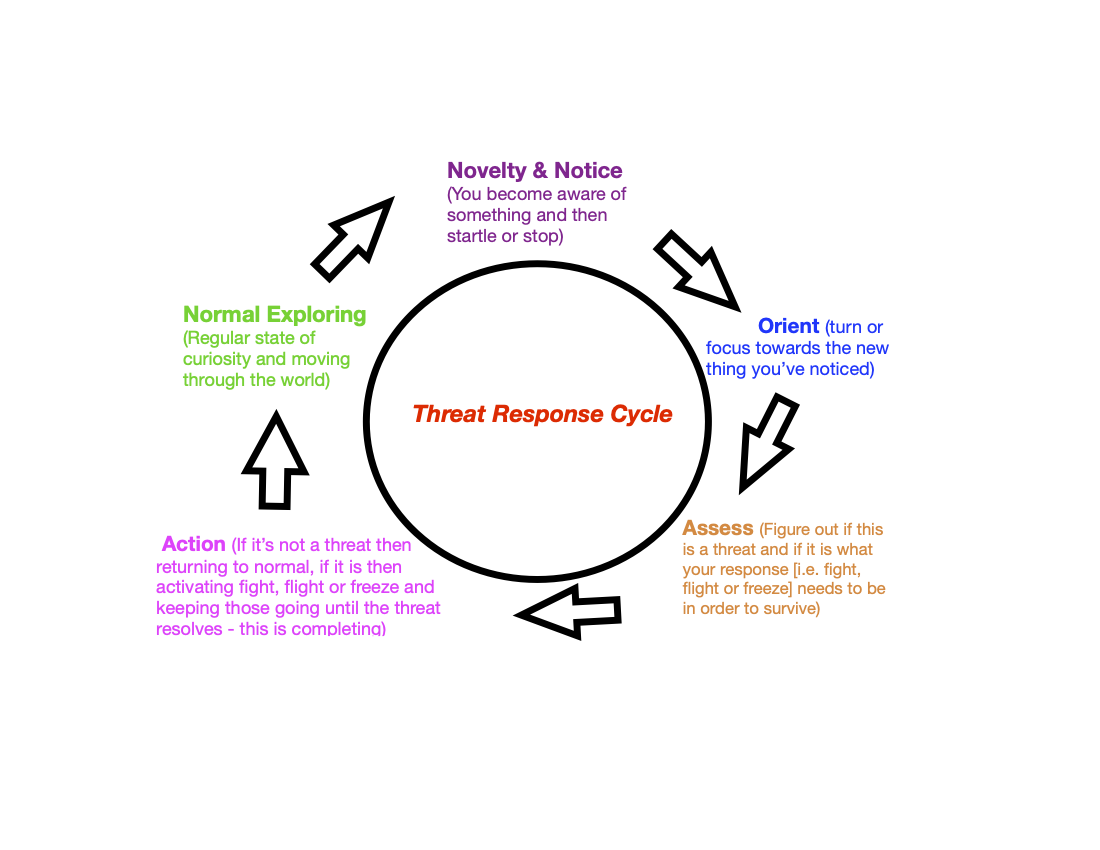
Our nervous system constantly, and unconsciously, scans for potential threats through an intricate process, Dr. Stephen Porges calls Neuroception. When something is detected it begins another unconscious process called, the Threat Response Cycle. This fundamental mechanism shapes how we interact with our environment and respond to new experiences, operating anywhere from milliseconds to extended periods.
Our nervous system constantly, and unconsciously, scans for potential threats through an intricate process, Dr. Stephen Porges calls Neuroception. When something is detected it begins another unconscious process called, the Threat Response Cycle. This fundamental mechanism shapes how we interact with our environment and respond to new experiences, operating anywhere from milliseconds to extended periods.
The Threat Response Cycle begins when we encounter something novel in our environment—whether through our senses or information we receive (e.g. a sound or a. Our attention naturally orients toward this new stimulus, leading to a critical assessment phase. During assessment, our system evaluates whether the stimulus represents a threat. If deemed safe, we return to a relaxed state. However, if identified as threatening, our body prepares for an appropriate response: fight, flight, or freeze.
A complete cycle concludes when we can execute our chosen response until the threat subsides, allowing us to return to our baseline state. However, complications arise when we cannot complete this cycle, particularly during the assessment phase.
Assessment disruption often occurs when we encounter situations where our natural threat response conflicts with other survival needs. Consider a child who perceives their parent as threatening but depends on them for survival, or a professional facing workplace harassment while fearing job loss. Similarly, those conditioned to suppress emotions like anger or fear may struggle to recognize these as valid threat responses.
This incomplete assessment creates a paradoxical situation: we must simultaneously acknowledge and ignore a threat. The resulting internal conflict can manifest as:
* Persistent anxiety without an apparent cause, as our system remains stuck in assessment mode without reaching resolution
* Emotional disconnection or avoidance behaviors, serving as unconscious protection mechanisms
* Difficulty adapting to new situations, as our threat response system remains partially engaged
Understanding this cycle helps explain why certain situations feel paralyzing despite no obvious danger. By recognizing these patterns, we can begin addressing the underlying disruptions in our threat response system and work toward more adaptive responses.
The Power of Play: How the PLAY System Supports Mental Health and Connection
At Analog Counseling, we believe in integrating the latest affective neuroscience insights to help our clients lead healthier, more connected lives. One of the most fascinating discoveries in this field is the PLAY system, identified by renowned affective neuroscientist Dr. Jaak Panksepp.
The PLAY system is one of seven core emotional systems in the brain, deeply rooted in our biology. It produces feelings of social joy, encourages creativity, and drives connection. But the benefits of play go far beyond fun—they’re vital for mental health, resilience, and survival.

Discover the Science Behind Play and Its Role in Emotional Well-Being
At Analog Counseling, we believe in integrating the latest affective neuroscience insights to help our clients lead healthier, more connected lives. One of the most fascinating discoveries in this field is the PLAY system, identified by renowned affective neuroscientist Dr. Jaak Panksepp.
The PLAY system is one of seven core emotional systems in the brain, deeply rooted in our biology. It produces feelings of social joy, encourages creativity, and drives connection. But the benefits of play go far beyond fun—they’re vital for mental health, resilience, and survival.
What Is the PLAY System?
The PLAY system originates in the brainstem, where it creates the neurochemical experiences that drive primary emotions. These emotions form the foundation of our consciousness, helping us process the world even before we think about it.
The primary function of the PLAY system is contingency seeking—our natural instinct to explore, try new things, and adapt to challenges. This playful curiosity enhances problem-solving and fosters social joy, an emotion that signals health and well-being to the mind and body.
Play also strengthens our connections with others, serving as a building block for social bonds. Research even suggests that play may have contributed to the development of language, a core element of human interaction.
Why Fear Blocks Play
Despite its benefits, play becomes impossible in the presence of high levels of fear or anxiety. When fear takes over, the brain perceives risks as real and immediate, preventing us from imagining possibilities or experimenting with new ideas.
This rigid mindset can trap us, much like wet concrete hardening into an unchangeable form. Without the flexibility to “play” with possibilities, our creativity, joy, and connection suffer.
The Role of Play in Mental Health
Understanding the PLAY system reveals how essential play is for mental health and personal growth. Play isn’t just for kids—it’s a biological necessity for adults too. It supports emotional resilience, strengthens social connections, and promotes creative thinking.
At Analog Counseling, we incorporate playful and exploratory techniques into therapies like Somatic Experiencing, psychoanalysis, and Enneagram coaching. By reconnecting with your capacity for play, you can reduce stress, overcome fear, and rediscover joy.
How to Bring Play Back Into Your Life
If fear or stress is blocking your ability to play, consider incorporating activities that spark curiosity, laughter, or creativity. Try:
• Physical movement like dancing or yoga.
• Creative activities like drawing, journaling, or playing music.
• Social activities that involve humor or light-hearted interaction.
Therapy can also be a powerful way to overcome emotional barriers to play. With professional support, you can create a safe space to explore possibilities, heal from past trauma, and rediscover your innate capacity for joy.
Start Your Journey to Joy and Connection
At Analog Counseling in Kansas City, we specialize in therapies that restore balance and foster well-being. Whether you’re struggling with anxiety, stress, or disconnection, our team can help you reconnect with the transformative power of play.
Contact us today to learn more about our services, including Somatic Experiencing, psychoanalysis, and online Enneagram coaching. Together, we can help you rediscover the joy, creativity, and resilience that come from embracing play.
Sources and Further Reading for Mental Health and Play
• Panksepp, J. (1998). Affective Neuroscience: The Foundations of Human and Animal Emotions. Oxford University Press.
• Panksepp, J., & Biven, L. (2012). The Archaeology of Mind: Neuroevolutionary Origins of Human Emotions. W.W. Norton & Company.
• Cozolino, L. (2014). The Neuroscience of Human Relationships: Attachment and the Developing Social Brain. W.W. Norton & Company.
Understanding Trauma Response in Psychotherapy: A Professional Guide
Trauma responses often underlie many reasons clients seek therapy. These manifest as bio-psychological markers indicating perceived personal threat: heightened anxiety, panic attacks, self-protective behaviors, and depression—even when no immediate threat exists.

Trauma responses often underlie many reasons clients seek therapy. These manifest as bio-psychological markers indicating perceived personal threat: heightened anxiety, panic attacks, self-protective behaviors, and depression—even when no immediate threat exists.
The Challenge of Trauma Response
The complexity lies in how trauma responses convince individuals that non-threatening situations are dangerous. While these responses feel adaptive, they often lead to:
Relationship deterioration
Persistent depression and anxiety
Career instability
Loss of motivation
General confusion and distress
Beyond Symptom Management
Many clients initially seek tools to manage symptoms—the thoughts, feelings, and behaviors that accompany their suffering. However, addressing these surface-level manifestations alone won't resolve the underlying body-mind trauma response.
Types of Trauma and Treatment Approaches
Treatment strategies vary depending on the trauma type:
Attachment and Developmental Trauma
These deeply embed within personality structures, affecting how individuals view themselves and others. Responses become automatic and habitual, influencing thoughts, emotions, and behaviors.
Shock and Event-Related Trauma
This typically manifests as environmental triggers connected to specific events. While it can become personalized, shock trauma often responds more readily to treatment when not deeply embedded in personality.
Need help understanding your trauma response? Contact us for a free 15-minute consultation at 913-294-769.
Understanding Your Body's Emotional Language
Did you know your body might be feeling emotions before your mind knows about them? Groundbreaking research in affective neuroscience by Dr. Jaak Panksepp shows we have seven basic emotional systems that can operate below our conscious awareness, especially when impacted by trauma.
Your body tells the story through various signals:

Did you know your body might be feeling emotions before your mind knows about them? Groundbreaking research in affective neuroscience by Dr. Jaak Panksepp shows we have seven basic emotional systems that can operate below our conscious awareness, especially when impacted by trauma.
Your body tells the story through various signals:
Your heart rate and blood pressure might spike during FEAR or RAGE
Your breathing pattern could shift during PANIC/GRIEF
Your muscle tension might increase during RAGE
Your skin conductance could change during SEEKING
Your body temperature might shift during CARE or LUST
Your movement patterns could indicate PLAY
When trauma impacts our ability to recognize emotions, these physical signals become even more important. They're like your body's emotional morse code, sending messages about feelings you might not consciously recognize. This is valuable because core emotions tell you how to adapt to life in order to best survive and grow.
New wearable technology is making it possible to track these bodily signals, potentially helping us reconnect with emotions we've learned to suppress. While this technology is still developing, it offers exciting possibilities for understanding our deeper emotional experiences.
Remember: Your body always knows. Learning to listen to these physical signals can be a powerful part of healing.
References:
Panksepp, J. (1998). Affective Neuroscience: The Foundations of Human and Animal Emotions
Panksepp, J., & Biven, L. (2012). The Archaeology of Mind: Neuroevolutionary Origins of Human Emotions