
The Power of Mentorship: A Two-Way Street for Men's Mental Health
Mentorship provides a unique framework for men to address mental health while maintaining a sense of purpose and contribution. Recent studies show that men are more likely to discuss personal challenges within the context of professional mentorship than in traditional therapeutic settings.

How Mentoring Relationships Support Mental Wellness
Mentorship provides a unique framework for men to address mental health while maintaining a sense of purpose and contribution. Recent studies show that men are more likely to discuss personal challenges within the context of professional mentorship than in traditional therapeutic settings.
Benefits of Mentorship for Mental Health:
For Mentors:
Increased sense of purpose
Improved emotional awareness
Enhanced communication skills
Expanded social connections
For Mentees:
Access to experienced guidance
Safe space for vulnerability
Professional and personal growth
Built-in support system
Creating Effective Mentorship Relationships
Start with clear expectations
Focus on both professional and personal development
Maintain regular check-ins
Allow the relationship to evolve naturally
Industry-Specific Considerations Different fields present unique mentorship opportunities:
Technology: Remote mentorship programs
Finance: Stress management focus
Healthcare: Burnout prevention
Manufacturing: Safety and wellness integration
Whether you're interested in becoming a mentor or finding one, the key is authenticity and commitment to growth.
Looking for support? Our counseling services offer specialized therapy for men navigating life transitions, relationship challenges, and professional development. Contact us to learn more about our individual counseling.
The Hidden Impact: Male Friendship, Divorce, and Mental Health
The Harvard Study of Adult Development reveals a striking finding: the quality of men's relationships is the strongest predictor of both happiness and health. Yet, modern life presents unique challenges to maintaining these crucial connections, particularly during major life transitions like divorce.

Understanding the Interconnected Challenges Men Face
The Harvard Study of Adult Development reveals a striking finding: the quality of men's relationships is the strongest predictor of both happiness and health. Yet, modern life presents unique challenges to maintaining these crucial connections, particularly during major life transitions like divorce.
The Friendship Challenge Research by Geoffrey Greif shows that men's friendships often:
Decrease significantly after age 30
Center around activities rather than emotional sharing
Become harder to maintain after marriage and children
Suffer during life transitions like divorce
The Divorce Factor When divorce enters the picture, men often face:
Loss of shared social networks
Reduced contact with children
Workplace performance challenges
Increased health risks
Dr. Felix Neto's research indicates that divorced men experience higher rates of depression than women post-divorce, yet are less likely to seek support.
Building Resilience Through Connection How can men maintain and build relationships during challenging times?
Join activity-based groups (sports teams, hobby clubs)
Seek male-specific support groups
Maintain regular check-ins with friends
Consider professional support during transitions
Remember: Building and maintaining connections isn't just about social life – it's about mental health and longevity.
Men's Mental Health: Breaking the Silence in Modern Life
Understanding and Addressing the Hidden Mental Health Crisis Among Men

Understanding and Addressing the Hidden Mental Health Crisis Among Men
In recent years, a silent crisis has been unfolding in men's mental health. While society has made significant strides in discussing mental health openly, men continue to face unique challenges in seeking and receiving support. Research from the American Psychological Association shows that only one in three men seek treatment for depression, despite experiencing it at significant rates.
Why are men reluctant to seek help? Dr. Michael Addis, author of "Invisible Men," points to traditional masculine norms that often prevent men from acknowledging emotional struggles. These norms can create what Dr. Ronald Levant terms "normative male alexithymia" – difficulty identifying and expressing emotions.
Signs That May Indicate Mental Health Challenges in Men:
Increased irritability or anger
Changes in work habits or performance
Risk-taking behavior
Social withdrawal
Physical symptoms like headaches or digestive issues
Sleep changes
Substance use
The good news? More men are breaking these patterns. Modern approaches to men's mental health focus on strength-based perspectives, viewing seeking help as a sign of courage rather than weakness.
Taking Action:
Start small - try mental health apps or online resources and don’t forget about audio self help books
Connect with peers who openly discuss mental health - getting coffee or drinks and talking about how it’s really going
Consider therapy approaches that align with your comfort level - take your time and interview many different therapists
Remember that mental health care is health care
Need support? We're here to help. We can help with all of the behaviors listed above. Contact us for a confidential consultation that respects your journey and pace.
The Dance of Parent and Child: Understanding Dr. Beebe's Groundbreaking Research
When we think about bonding with our babies, we often focus on the big moments - the first smile, the first word, the first steps. But Dr. Beatrice Beebe's fascinating research reveals that it's actually the tiny, split-second moments between parent and baby that shape their relationship and the child's future development.
Dr. Beatrice Beebe explains microanalysis—an in-depth method for studying moment-to-moment interaction, affect regulation, and relational patterns in psychotherapy and early development.
When we think about bonding with our babies, we often focus on the big moments - the first smile, the first word, the first steps. But Dr. Beatrice Beebe's fascinating research reveals that it's actually the tiny, split-second moments between parent and baby that shape their relationship and the child's future development.
Using advanced video technology, Dr. Beebe captures these fleeting exchanges, analyzing them frame by frame. What she discovers is remarkable: at just four months old, babies are already engaged in an intricate dance of communication with their caregivers. Each facial expression, each coo, each tiny movement is part of a complex conversation.
Think of it like a tennis match in slow motion. When a baby makes a sound or expression, how quickly and appropriately does the parent respond? Dr. Beebe calls this "contingent communication," and it helps babies learn to make sense of their social world. It's through these exchanges that babies begin to understand themselves and learn to regulate their emotions.
But here's the surprising part - parents don't need to be perfect. In fact, Dr. Beebe's research shows that trying to be in perfect sync with your baby isn't ideal. Instead, what she calls "mid-range" attunement - where parents are generally responsive but sometimes miss cues and then repair these moments - actually helps babies develop more resilience. It's like learning to dance; occasional missteps and recoveries are part of the process.
Her research also reveals that balance is key. Just as under-engagement can leave a baby feeling disconnected, too much engagement can be overwhelming. By studying these patterns at four months, Dr. Beebe can even predict how secure a child's attachment will be at one year old - information that's invaluable for supporting healthy parent-child relationships.
Understanding these microscopic moments of connection gives us a new lens through which to view early relationships. It reminds us that every small interaction matters, while also reassuring parents that perfect attunement isn't the goal. Instead, it's about being present, responsive, and willing to repair those inevitable moments of misconnection.
In 2017 I had the great fortune of spending a day with Dr. Beebe in her lab at Columbia University in NYC, as a part of my psychoanalytic training. Seeing her lab and hearing her teach these things first hand was absolutely game changing for me. I hope her work inspires you as it does me.
Walking with the storm: Helping your loved ones when they’re overwhelmed
Download our free guide to helping your loved ones when they’re overwhelmed.
Navigating Parenthood: A Practical Guide to Compassionate Communication
Download Analog Counseling’s “Good Enough Parenting” FREE mini guide here!
Understanding the Unconscious Mind: What Lies Beneath Our Awareness
We all have parts of ourselves that remain hidden from our everyday awareness – thoughts, feelings, and memories that shape our behavior without us even knowing it. This is what psychologists call the unconscious mind, and understanding it can be key to personal growth and healing.

We all have parts of ourselves that remain hidden from our everyday awareness – thoughts, feelings, and memories that shape our behavior without us even knowing it. This is what psychologists call the unconscious mind, and understanding it can be key to personal growth and healing.
What Exactly Is the Unconscious?
At its core, the unconscious is like a storage room in our mind where we keep difficult emotions and memories that we weren't able to fully process at the time they occurred. Think of it as an emotional filing system that operates behind the scenes of our conscious awareness.
How Does It Work?
When we encounter painful or overwhelming experiences, especially during childhood, we often lack the tools or support to handle them effectively. Imagine a young child facing a scary situation – they might cope by distracting themselves with toys or retreating into their imagination. While this works in the moment, it becomes an automatic response that gets deeply encoded in their system.
This coping mechanism then becomes our default setting. Like a well-worn path in a forest, our mind automatically follows these familiar routes of distraction or avoidance whenever similar situations arise. The original painful memories and emotions remain stored in our unconscious, influencing our behavior in ways we might not recognize.
Why Does This Matter?
Understanding our unconscious mind is crucial because these stored memories and emotions don't simply disappear. They continue to affect our:
Relationships with others
Emotional responses to everyday situations
Decision-making processes
Overall well-being
The Path to Awareness
The good news is that with support and the right tools, we can begin to understand these unconscious patterns. Through therapy and self-reflection, we can gradually bring awareness to these automatic responses and develop new, more helpful ways of dealing with difficult emotions and memories.
Remember, our unconscious mind developed these patterns to protect us when we had no other options. Acknowledging this with compassion is the first step toward healing and growth.
Want to learn more about understanding your unconscious mind and developing healthier coping mechanisms? Contact our experienced therapists at Analog Counseling today.
Understanding Men's Mental Health: Breaking Down Barriers to Care
Recent research has highlighted a concerning pattern: men face unique obstacles when it comes to accessing mental health support, with stigma and traditional masculine norms playing crucial roles.

Mental health challenges don't discriminate, but the way different groups experience and seek help for these challenges can vary significantly. Recent research has highlighted a concerning pattern: men face unique obstacles when it comes to accessing mental health support, with stigma and traditional masculine norms playing crucial roles.
Why Should We Care? Men are more than twice as likely to die by suicide compared to women worldwide, yet they're less likely to seek help for mental health concerns. This paradox points to a critical public health issue that demands our attention.
The Triple Challenge Recent research reveals three main barriers that prevent men from seeking mental health support:
Masculine Identity Conflicts Many men view seeking help as conflicting with traditional masculine ideals of strength and self-reliance. This internal struggle often leads to:
Reluctance to acknowledge emotional difficulties
Tendency to isolate when struggling
Fear of being seen as "weak" or "unmanly"
Social and Cultural Barriers The environment men live and work in can significantly impact their help-seeking behavior:
Workplace cultures that stigmatize mental health discussions
Sports environments that prioritize "mental toughness"
Cultural expectations about masculinity and strength
Additional challenges for men from minority communities
Healthcare System Challenges The mental healthcare system itself can present barriers:
Perceived "feminization" of mental health services
Limited male-specific mental health promotion
Economic barriers to accessing care
Lack of culturally competent care for diverse populations
What Works? Promising Solutions Research suggests several effective approaches to improve men's engagement with mental health services:
Male-Sensitive Approaches
Using action-oriented, solution-focused language
Framing help-seeking as a sign of strength
Providing practical, goal-directed therapy options
Community-Based Support
Creating male-centric support networks
Utilizing peer support programs
Developing safe spaces for men to share experiences
Public Health Initiatives
Targeted mental health campaigns for men
Use of male role models in mental health promotion
Education about mental health in male-dominated spaces
Moving Forward Breaking down these barriers requires a multi-faceted approach. Healthcare providers, employers, and community organizations all have roles to play in creating more accessible and acceptable mental health support for men.
Professional Implications For mental health professionals, this research suggests:
The importance of understanding masculine norms and their impact on therapy
Need for tailored approaches that respect men's communication preferences
Value of incorporating strength-based perspectives in treatment
Importance of cultural competency in working with diverse male populations
The good news? When men do access appropriate mental health support, they often experience positive outcomes. The challenge lies not in treatment effectiveness, but in making services more accessible and acceptable to men who need them.
References:
Duthie, G., et al. (2024). The impact of media-based mental health campaigns on male help-seeking: a systematic review. Health Promotion International, 39, daae104.
Shepherd, G., et al. (2023). The challenges preventing men from seeking counselling or psychotherapy. Mental Health & Prevention, 31, 200287.
McKenzie, S.K., & Oliffe, J.L., et al. (2023). Men's Mental Illness Related Stigmas: A Scoping Review of Qualitative Literature.
These research reviews collectively analyzed over 80 studies examining men's mental health help-seeking behaviors and barriers to care, providing a comprehensive picture of current challenges and potential solutions in supporting men's mental health.
[Note: This blog post is designed to be informative while remaining accessible to a general audience. Healthcare professionals should consult the original research for detailed clinical recommendations.]
Understanding Inner Attention: A Path to Emotional Awareness
Have you ever noticed how you're constantly aware of your inner experiences - feeling anxious before a presentation, or bored during a long meeting? This natural awareness is what we call "attention inward." While we all do this automatically throughout our day, there's a deeper, more intentional way of turning our attention inward that's used in therapeutic approaches like Somatic Experiencing. This specialized practice can reveal insights about ourselves that usually remain hidden.

In a previous post we talked about attention out. In this post we’ll talk about attention in.
Have you ever noticed how you're constantly aware of your inner experiences - feeling anxious before a presentation, or bored during a long meeting? This natural awareness is what we call "attention inward." While we all do this automatically throughout our day, there's a deeper, more intentional way of turning our attention inward that's used in therapeutic approaches like Somatic Experiencing. This specialized practice can reveal insights about ourselves that usually remain hidden.
How Emotions Guide Us
Dr. Mark Solms's research helps us understand that emotions aren't just feelings - they're sophisticated guidance systems that help us survive and thrive. Think of emotions as messengers carrying important information. When we feel sad, for instance, that sadness is telling us we've lost something meaningful. More importantly, it's guiding us toward natural ways to heal: crying, seeking comfort from loved ones, or taking time for self-care.
But what happens when we can't follow these natural emotional pathways? Maybe we grew up learning that "big kids don't cry" or that showing vulnerability is weakness. When this happens, we develop coping mechanisms - like pushing the feeling away, distracting ourselves, or rationalizing why we shouldn't feel that way. Over time, these coping strategies become so automatic that we mistake them for our natural responses. It's like creating a detour around a blocked road and eventually forgetting the original route altogether.
A Different Way of Paying Attention
This is where intentional inner attention becomes valuable. By carefully observing our internal experience, we can reconnect with our authentic emotional responses that have been masked by years of coping strategies. Somatic Experiencing offers a helpful framework for this kind of attention through the SIBAM model:
Sensations: Physical feelings in your body (butterflies in your stomach, chest tightness, warmth, tingling)
Images: Mental pictures or memories that arise
Behaviors: Natural impulses to move or react
Affect: Conscious emotional experiences
Meaning: Our thoughts and interpretations
In our thinking-focused culture, we often jump straight to meaning-making - trying to analyze and understand before we've fully experienced our emotions. However, if we can learn to pause and first notice our bodily sensations, images, and impulses, we often discover clearer and more authentic information about our emotional needs.
This patient, body-first approach helps us bypass our habitual coping mechanisms and reconnect with our natural emotional wisdom. By learning to pay attention in this way, we can begin to untangle the difference between our authentic responses and our learned coping strategies.
Understanding Your Body's Alert System: A Guide to Feeling Safer in Everyday Life
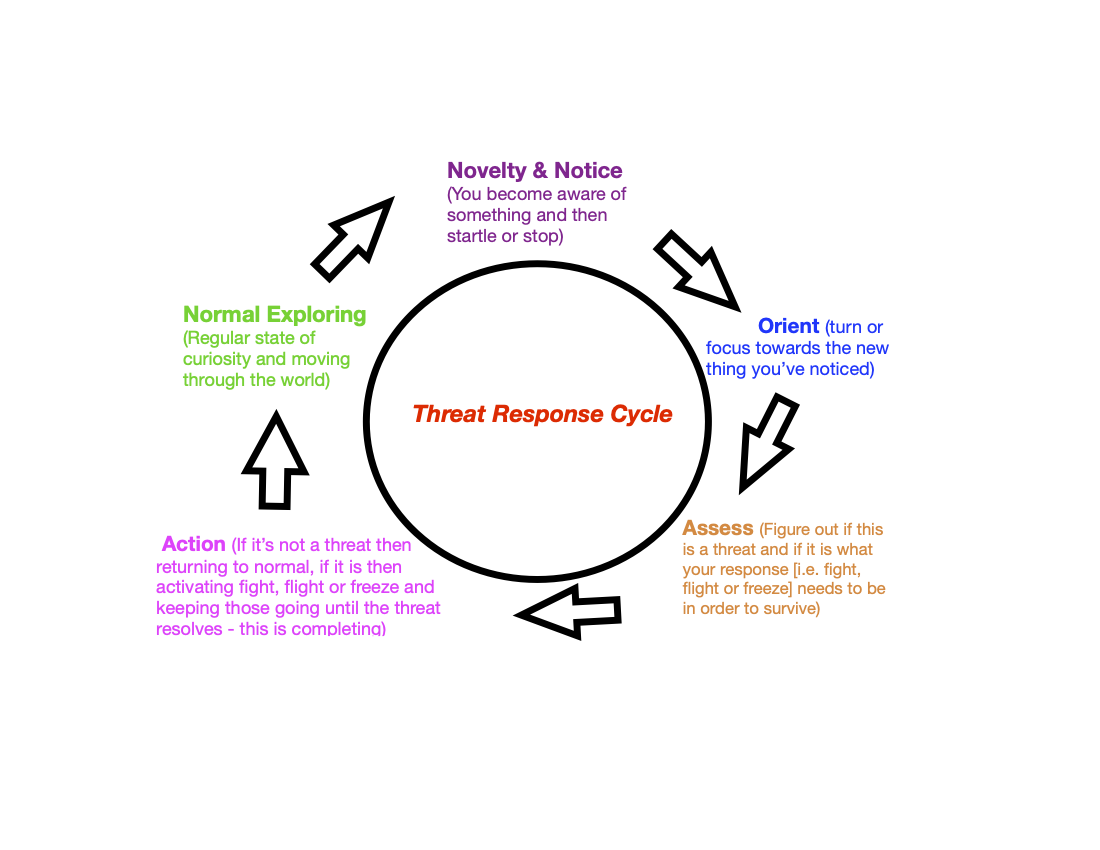
Ever notice how your body reacts when you open a stressful email or get into an argument? That racing heart, those tense shoulders - these aren't random reactions. They're part of your body's natural alert system called the threat response cycle, and understanding this system can change your life in wonderful ways.
Ever notice how your body reacts when you open a stressful email or get into an argument? That racing heart, those tense shoulders - these aren't random reactions. They're part of your body's natural alert system called the threat response cycle, and understanding this system can change your life in wonderful ways.
Your Built-In Safety System
Think of your body as having a special safety alarm, an instinct for safety. Just like our ancestors needed this alarm to stay safe from wild animals, we use it today in our modern world. This system kicks in when:
Reading a difficult email
Sitting through a tense meeting
Having a disagreement with someone you love
Walking into a crowded restaurant
Even chatting with a friend when a sensitive topic comes up
The Threat Response Cycle
Why Understanding This Matters
When you know how your alert system works, you gain a superpower: the ability to pause and check if you really need to be on high alert. Sometimes your alarm might go off when you're actually safe, like feeling panicked about giving a presentation to friendly colleagues. Other times, you might not notice real warning signs when you should, like staying in an unhealthy situation for too long.
Taking Back Control
The good news? Once you recognize when your alert system is active, you can:
Take a moment to pause
Look around and check if there's a real reason for concern
Choose how to respond rather than just react
Return to feeling calm and present when you realize you're safe
This awareness helps you move through your day with more peace and confidence. Instead of being controlled by automatic reactions, you can choose how to respond to life's challenges.
Remember: Your alert system isn't your enemy - it's trying to protect you! Learning to work with it, rather than against it, can help you feel more in control and at peace in your daily life.