
Mapping the self: a guide to emotional healing and wholeness
Emotions are your body’s internal GPS. They aren’t obstacles—they’re signals that something needs attention.
They arise before conscious thought and aim to help you regulate, connect, and adapt. But when we block emotions—due to trauma, fear, shame, or survival needs—they go underground and show up as distress, anxiety, numbness, or disconnection.
By Analog Counseling & Consulting Services
Emotions Aren’t the Problem—They’re the Map
Emotions are your body’s internal GPS. They aren’t obstacles—they’re signals that something needs attention.
They arise before conscious thought and aim to help you regulate, connect, and adapt. But when we block emotions—due to trauma, fear, shame, or survival needs—they go underground and show up as distress, anxiety, numbness, or disconnection.
The Triangle of Conflict and Change: A Map for Healing
Based on the work of Hilary Jacobs Hendel, Diana Fosha, and David Malan the Triangle of Conflict and Change helps us move from distress and defenses toward clarity and connection.
1. Defenses (Top Left)
Anything we do to avoid feeling:
- Overthinking
- Numbing
- Blaming
- Scrolling
- Addictions
- Perfectionism
2. Inhibitory Emotions (Top Right)
These are the “red lights” of our emotional system:
- Anxiety: Am I safe?
- Shame: I am bad.
- Guilt: I’ve done something bad.
They block access to deeper core emotions.
3. Core Emotions (Bottom Point)
These are biological, adaptive feelings:
- Grief / Panic
- Rage
- Lust
- Play (Social Joy)
- Fear
- Care
- Seeking (Motivation / Curiosity)
Trauma: A Stuck Emotional Response
Trauma is not the event itself—it's what the nervous system does after the event.
When emotional responses can't complete (crying, running, connecting, yelling), they stay stuck. The nervous system gets trapped in fight/flight/freeze. Instead of completion, we move into coping (i.e. defenses).
What Inhibitory Emotions Feel Like
Anxiety
- Racing heart
- Tight chest
- Breathlessness
- Dizziness
- Racing thoughts
- Nausea
Guilt
- Muscle tension
- Crying
- Restlessness
- Insomnia
Shame
- Feeling exposed
- Frozen
- Wanting to hide
- Blushing or hot
- Feeling “less than”
The Threat Response Cycle
Novelty → Orient → Assess → Respond → If needed Fight/Flight/Freeze → Rest
In trauma, completion of the response doesn't happen so we never get to the “rest” part. The system stays alert, reactive, and to cope with that dysregulation we dissociate through using defendes. The body never feels safe enough to feel as long as the original dysregulation maintains without support or help.
How to Work the Triangle
1. Undo the Defenses
- Notice what defense you're using
- Reflect on how it feels to be defended
- Thank the defense—it's trying to protect you
- Gently ask it to step aside and observe what happens
2. Calm and soothe the nervous system from the Inhibitory Emotions
Use somatic tools like:
- Name that you are feeling a red light emotion
- Physiological Sigh (i.e. the double inhale)
- Orienting to notice you are safe and to give your nervous system a chance to reset (a specific Somatic Experiencing skill)
- Focusing on lowering heartrate, softening muscles, deepening breath, etc.
3. Build Safety With Emotions
Use somatic tools like:
- Voo breathing
- Grounding (feet, breath, body awareness)
- Swaying, walking, rocking
- Journaling, art, or music to evoke and explore emotion
4. Practice Feeling in Safe Ways
- Start slow—don’t flood yourself - focus on restful/calm/strong/positive feelings first
- If you start to notice tension in your body, as long as it's not overwhelming or flooding, stay with it until the wave of actation dies down stay with the sensations themselves to do this
- After a wave of activation and de-activation journal about the feelings and memories that you experienced
- Share how you feel with someone you trust
- Notice how it feels to be heard
Two Powerful Healing Modalities
Somatic Experiencing (SE)
Helps the body complete stuck trauma responses through:
- Grounding & orienting
- Gentle touch work
- Tracking bodily sensation
- Building capacity to feel safely
EMDR Therapy
A structured process that helps “digest” traumatic memories:
- Recall a memory while using eye movements or tapping
- Let feelings, images, and beliefs surface
- Notice how the memory shifts or lightens over time
Your Healing Goals
The goal isn’t to “get rid” of emotions. It’s to feel them safely, let them guide you, and return to your authentic self.
You can learn to:
- Calm your physiology
- Understand your emotional cues
- Feel without shutting down or overreacting
- Reconnect to others in meaningful ways
Summary: Mapping the Self
- Emotions are Signals: Not problems. They tell us what we need.
- Trauma is Dysregulation: Not just the event. It’s what sticks.
- Healing = Feeling: Safely, with support, and in the body.
- Defenses + Red Light Emotions = Blocks
- Core Emotions = Authenticity + Adaptation
- Therapies like SE and EMDR help complete the cycle
References
- Hendel, H.J. (2018). It’s Not Always Depression
- Panksepp, J. & Biven, L. (2012). The Archaeology of Mind
- Porges, S. (2017). The Pocket Guide to the Polyvagal Theory
- Levine, P. (2010). In an Unspoken Voice
- Solms, M. (2021). The Hidden Spring
- Badenoch, B. (2017). The Heart of Trauma
*If you ever become flooded or overwhelmed stop the exercise and comfort/soothe yourself. Then consider waiting to engage the feelings again until with a professional.
Understanding the change triangle and it’s relation to somatic experiencing
The Change Triangle is a practical map of emotions developed by Hilary Jacobs Hendel, grounded in accelerated experiential dynamic psychotherapy (AEDP), affective neuroscience (especially the work of Jaak Panksepp), and psychodynamic theory. It's designed to help people move from states of anxiety, shame, and depression toward core emotions, open-hearted states, and authentic connection with self and others.
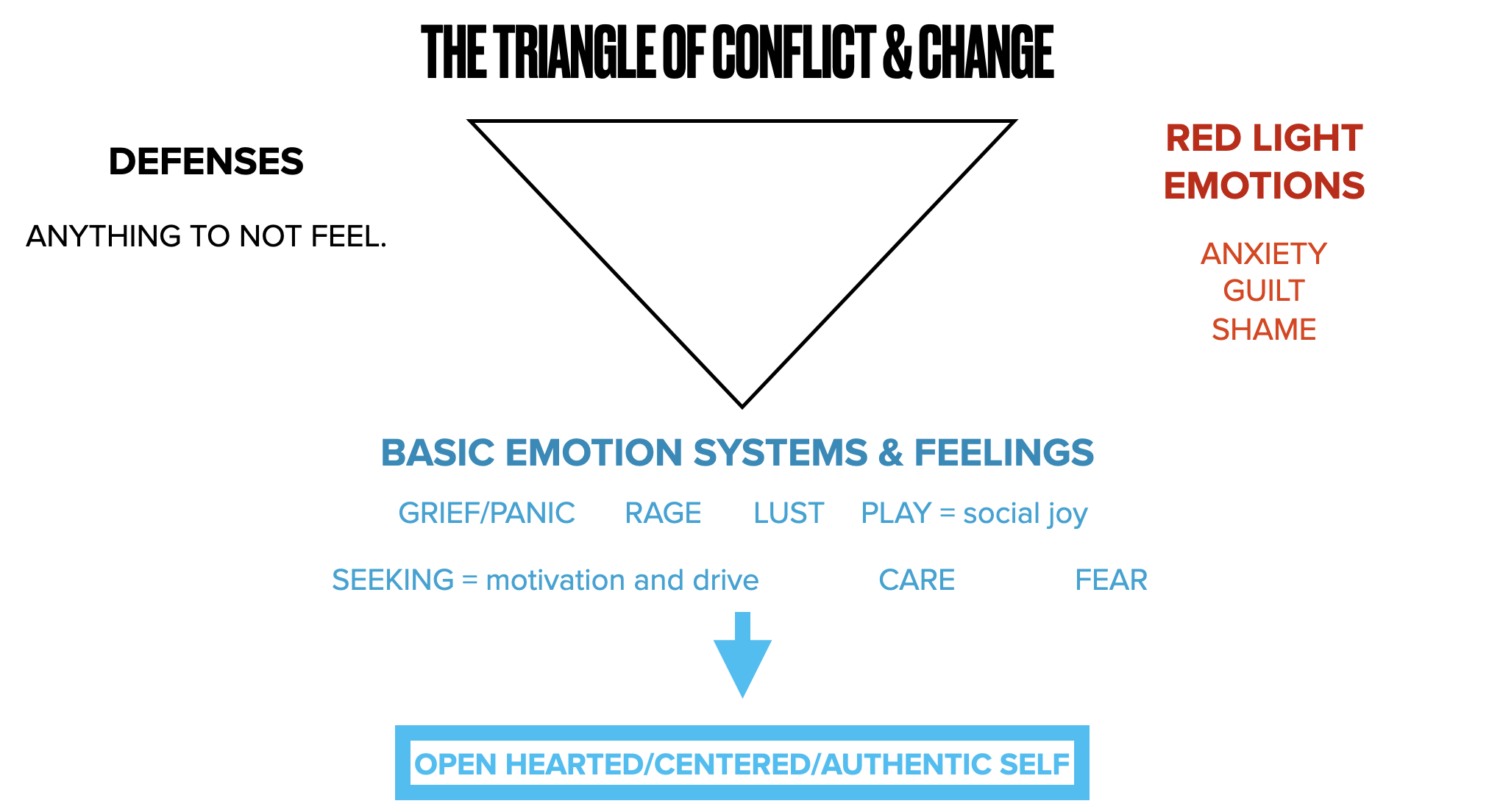
This is an image I made that is slightly different than Hendel or Fosha or Malan’s triangle. It uses Panksepp’s basic emotion systems and integrates in Porges’ Polyvagal Theory.
The Change Triangle is a practical map of emotions developed by Hilary Jacobs Hendel, grounded in accelerated experiential dynamic psychotherapy (AEDP), affective neuroscience (especially the work of Jaak Panksepp), and psychodynamic theory. It's designed to help people move from states of anxiety, shame, and depression toward core emotions, open-hearted states, and authentic connection with self and others.
Overview of the Change Triangle
The triangle has three points:
Top Corners (Defensive & Inhibitory Emotions):
Defensive behaviors (e.g., sarcasm, people-pleasing, intellectualizing) block emotional experience.
Inhibitory emotions include (I used the title “Red Light Emotions” above):
Anxiety
Shame
Guilt
These act like red lights, blocking or overriding core emotional experience.
Bottom Point (Core Emotions):
These are universal, biological, adaptive emotional responses hardwired in the brain.
Core emotions include (again - in the image above I’m using Panksepp’s core emotion systems vs the emotion list from Hendel as listed below):Anger
Sadness
Fear
Joy
Excitement
Disgust
Sexual excitement
Authentic Self (Middle of the Triangle):
When core emotions are felt and processed fully, a person can access their authentic self, characterized by clarity, calm, confidence, and connection.
Inhibitory Emotions in the Nervous System
1. Anxiety
A global arousal signal of the autonomic nervous system (ANS), especially the sympathetic branch (fight or flight). It arises when core emotions are experienced but cannot be tolerated or expressed safely.
Brain regions:
Amygdala: hyperactive in threat detection
Hypothalamus: triggers HPA axis → cortisol release
Insula: processes internal sensations (interoception)
Prefrontal cortex: may attempt to suppress emotional awareness
Somatic markers: Rapid heartbeat, muscle tension, restlessness, tight chest, shallow breathing
Reference: Porges, S. (2017). The Pocket Guide to the Polyvagal Theory; LeDoux, J. (2015). Anxious: Using the Brain to Understand and Treat Fear and Anxiety
2. Shame
An inhibitory emotion triggered by perceived failure to meet social or internal standards. It shuts down expression of vulnerable states.
Biological function: Social protection. Prevents ostracism by curbing behavior that could threaten connection or belonging.
Brain regions:
Medial prefrontal cortex: self-evaluation
Anterior cingulate cortex: emotional pain and conflict
Periaqueductal gray: immobility response (freezing)
Somatic markers: Collapse posture, averted gaze, facial flushing, desire to hide or disappear
Reference: Nathanson, D. L. (1992). Shame and Pride: Affect, Sex, and the Birth of the Self; Gilbert, P. (2003). Evolution, Social Roles, and the Differences in Shame and Guilt
3. Guilt
Another socially-oriented inhibitory emotion, guilt helps preserve social bonds by motivating reparative actions when behavior conflicts with moral values.
Brain regions:
Ventromedial prefrontal cortex: decision-making tied to values
Temporal parietal junction: perspective-taking
Insula: subjective emotional awareness
Somatic markers: Sinking stomach, tight chest, sense of heaviness, tears
Reference: Zahn, R. et al. (2009). “Social Concepts Are Represented in the Superior Anterior Temporal Cortex.” Proceedings of the National Academy of Sciences
Why They Block Core Emotions
Inhibitory emotions function like internal brakes. They arise when core emotions trigger conflict, fear of rejection, internalized shame scripts, or trauma-based reactions. For example:
Feeling anger → triggers shame (“I’m bad for feeling this”) → emotion gets blocked
Feeling sadness → triggers anxiety (“If I cry, I’ll lose control”) → body tightens, emotion suppressed
Rather than expressing the core emotion, the person may default to defensive behaviors (e.g., pleasing, avoiding, dissociating).
Somatic View: How They Exist in the Body
Peter Levine's Somatic Experiencing and Porges’ Polyvagal Theory explain that inhibitory emotions often result from overcoupling — when activation of core emotion is paired with danger signals from the body.
The nervous system constricts, narrows awareness, and attempts to “shut down” to maintain regulation and social safety.
Over time, chronic reliance on inhibitory emotions leads to:
Autonomic dysregulation (chronic sympathetic or dorsal vagal dominance)
Disconnection from felt sense
Reduced affect tolerance and expression
Reference:
Levine, P. (2010). In an Unspoken Voice
Panksepp, J. (2012). The Archaeology of Mind
Hendel, H. J. (2018). It’s Not Always Depression
The Seduction of Thinking: When We Mistake Analysis for Feeling
In therapy, I often ask clients, “Can you describe what you’re feeling—what it actually feels like?” I’m inviting them into their embodied experience: the tightness in the chest, the flutter in the stomach, the heat behind the eyes. But more often than not, what I hear back is, “It feels like it means…”
This response is familiar—and telling.

In therapy, I often ask clients, “Can you describe what you’re feeling—what it actually feels like?” I’m inviting them into their embodied experience: the tightness in the chest, the flutter in the stomach, the heat behind the eyes. But more often than not, what I hear back is, “It feels like it means…”
This response is familiar—and telling.
Our culture rewards insight, action, and interpretation. We’re praised for what we make of a moment, not for the quiet work of sensing and staying. Slowing down to feel is not something we’re taught, and if we’ve experienced trauma, it may not even feel safe. Trauma trains the body to cope, not feel. And in the absence of safety, thinking becomes a powerful—if unintentional—way to avoid feeling altogether. It can even become part of our identity, “a thinking person not a feeling person”.
But this avoidance comes at a cost.
When we think in place of feeling, we lose access to vital information that arises from within. Our nervous system isn’t waiting on us to invent meaning—it already knows. But its language is slow, subtle, and bodily. It needs space, and sometimes support, to speak—and for us to listen.
When we short-circuit this process with premature interpretation, we miss out on:
Knowing when we don’t feel safe
Recognizing when we do
Clarifying what we want
Sensing the emotional tone in a room (social intelligence)
Accessing the deeper, creative problem-solving that emerges from felt awareness
These aren't just “soft skills.” They are central to how we live, love, and make decisions. And without them we run the risk of living blindly.
The work, then, is to notice when we're thinking instead of feeling—and gently return to the body. That’s where the real conversation begins.
The Cult of Meaning-Making: When Thinking Hijacks Feeling
In our fast-paced culture, thinking is often elevated as the highest human function—our prized problem-solver, meaning-maker, and escape hatch. But thinking, as necessary as it is, can become a trap. Especially when it overrides our capacity to feel.

In our fast-paced culture, thinking is often elevated as the highest human function—our prized problem-solver, meaning-maker, and escape hatch. But thinking, as necessary as it is, can become a trap. Especially when it overrides our capacity to feel.
Neuroscience tells us that emotions come first. Literally. We feel before we think. Research by Jaak Panksepp and Lucy Biven (2012) demonstrates that emotional experience arises from deep subcortical structures in the brain—what they call the “core self”—before the neocortex (the seat of conscious thought) even gets involved.
Yet when we feel overwhelmed, vulnerable, or dysregulated, we often reach for thinking as a shield. We lean into analysis, planning, interpreting—often without realizing we're doing it to avoid the raw intensity of emotion. This pattern shows up neurologically in the dominance of the left prefrontal cortex—what psychiatrist and philosopher Iain McGilchrist (2010) describes as the left hemisphere’s narrow, detail-focused grasp on the world.
McGilchrist’s work reveals that the left hemisphere, especially the top-left-frontal region, tends to "make meaning" even when it lacks full data. It creates interpretations to soothe uncertainty—even if the result is distorted, fragmented, or, frankly, wrong. It favors coherence over truth. It would rather invent an answer than admit it doesn't know.
And here’s the rub: the left brain doesn’t have direct access to the richness of lived experience. It depends on the right hemisphere—our embodied, relational, and emotionally attuned brain—for that. The left side is secondary. A translator. A map-maker, not a navigator. As McGilchrist puts it, “The right hemisphere sees the whole, the left sees the parts and confuses the map for the territory” (McGilchrist, 2010).
The danger is cultural as well as personal. A society dominated by left-brain modes of thought can become obsessed with control, explanation, and certainty. Feeling is dismissed as irrational. Intuition is sidelined. Opinion replaces embodied knowing. As a result, we become more reactive, less reflective—and more cut off from ourselves.
But there’s another way.
Like many in the fields of affective neuroscience and psychotherapy, I invite a return to the wisdom of the body. As developmental neuropsychologist Allan Schore (2012) suggests, we can "shift down and to the right"—from the high-speed highways of left-brain cognition to the slower, more relational terrain of the right hemisphere and subcortical brain.
This shift asks us to pause. To feel. To listen to our body’s signals—its tension, breath, heart rate, gut response—before rushing to interpret or explain. It’s in this space, Schore says, that self-regulation becomes possible. And once we’re regulated, the deeper wisdom stored in our emotional and somatic systems begins to rise.
Our nervous systems are not just reactive—they're adaptive. But they need time. Time to feel before we think. Time to notice before we narrate. Time to allow the truth of our experience to emerge from the inside out—not be forced from the top down.
So let’s resist the cult of premature meaning-making. Let’s be willing to not know for a little while longer. In that not-knowing, something truer may take shape.
References
Panksepp, J., & Biven, L. (2012). The Archaeology of Mind: Neuroevolutionary Origins of Human Emotion. W. W. Norton & Company.
McGilchrist, I. (2010). The Master and His Emissary: The Divided Brain and the Making of the Western World. Yale University Press.
Schore, A. N. (2012). The Science of the Art of Psychotherapy. W. W. Norton & Company.
Supporting a Loved One Through a Panic Attack: A Resource for Family Members, etc.
Panic attacks are overwhelming surges of fear or distress, often accompanied by racing heart, shallow breathing, dizziness, and the intense feeling that something terrible is about to happen. Though they are not physically dangerous, they are emotionally intense and deeply unsettling to witness or experience.

In the previous post, I wrote about how to survive a panic attack. In this post, we’ll explore how to support our loved ones when they are suffering panic.
Panic Attacks Are Not Just "All in Their Head"
Panic attacks are overwhelming surges of fear or distress, often accompanied by racing heart, shallow breathing, dizziness, and the intense feeling that something terrible is about to happen. Though they are not physically dangerous, they are emotionally intense and deeply unsettling to witness or experience.
Key insight: Panic is often rooted in attachment distress — a reaction in the brain's emotional systems that signals threat, disconnection, or vulnerability. Neuroscientist Jaak Panksepp identified PANIC/GRIEF as one of the brain’s core emotional systems — the same system activated during separation, loss, or loneliness.
What Panic Attacks Feel Like to the Person Experiencing One:
“I think I’m dying.”
“I feel like I can’t breathe.”
“I’m going crazy.”
“I have to get out of here.”
These thoughts are often not rational — they are physiological reactions.
What Family Members May Feel:
Helpless
Anxious or panicked themselves
Frustrated or confused
Unsure what to do or say
Important: The more confident and calm you can stay, the more their nervous system can begin to settle.
How to Help During a Panic Attack
DO:
Speak gently and slowly. Try: “You’re safe right now. I’m here.”
Guide them to breathe slowly (match your breath with theirs if they can’t follow commands).
Help them orient: “Can you look around and name 5 things you see?”
Offer presence, not solutions (don’t ask a bunch of questions): Sit beside them, be steady.
Use their name. If appropriate, offer a hug, or touch their shoulder or hand gently (only if welcomed).
Afterward, offer water or something grounding (a cool cloth, weighted blanket, or walk).
DON’T:
Say “calm down” or “you’re overreacting.”
Ask them to explain or justify their feelings.
Leave unless they ask for space and are safe.
Understanding the Emotions Behind Panic: The Change Triangle (from the work of Hilary Jacobs Hendel)
The Change Triangle shows how we often move from core emotions (like fear, sadness, anger, joy) → to anxiety or panic → and then to defenses (like shutting down, lashing out, numbing). Panic attacks may appear out of nowhere, but they are often a signal that unprocessed core emotions have built up or been avoided.
Helping someone move from panic toward core emotion (like grief or fear) and then to connection or relief takes time, presence, and a calm environment.
You Are Not Their Therapist — But You Are Their Anchor
Your role is not to fix or diagnose. Your role is to be a safe attachment figure — someone whose presence says: “You are not alone in this.”
Think of yourself as a calm dock as they ride out a storm. You don’t have to stop the storm. Just stay close.
Helping Yourself While Helping Them
Take a deep breath yourself.
Remind yourself: “This is hard, but I can stay with it.”
Reach out to your own support system if needed.
Reflect on what you need afterward (rest, time alone, reassurance).
Repeat This to Yourself:
“This is not forever. This is a nervous system in distress. My steady presence helps.”
How to survive a panic attack
Many people have panic attacks or panic episodes. Panic might be one of the most misunderstood experiences in mental health. This is because many people don’t understand where panic is rooted in the brain and what that brain placement means. In the next post I will write about the meaning of panic attacks and how to support a loved one in a panic attack. For this post, here are immediate techniques you can try.

Many people have panic attacks or panic episodes. Panic might be one of the most misunderstood experiences in mental health. This is because many people don’t understand where panic is rooted in the brain and what that brain placement means. In the next post I will write about the meaning of panic attacks and how to support a loved one in a panic attack. For this post, here are immediate techniques you can try.
IMMEDIATE PANIC ATTACK TECHNIQUES
(Fast-acting methods to reduce panic and re-regulate)
1. Physiological Sigh (double inhale)
How to do it:
Inhale once through the nose
Take a second quick inhale on top
Exhale slowly and fully through the mouth
→ Repeat 1–3 times
Why it works:
Rapidly reduces CO₂ and calms the autonomic nervous system by engaging the parasympathetic “brake.”
Source: Huberman Lab, Stanford Neuroscience; Zelano et al., 2016
2. Orienting (Somatic Experiencing®)
How to do it:
Let your eyes slowly scan the environment
Notice colors, shapes, light, or movement
Gently turn your head as you do this
Let your body follow what feels interesting or settling
If rocking or swaying or other movement is spontaneous during this that’s fine too
Say to yourself:
“I’m here. I can look around. There’s no immediate danger.”
Why it works:
Engages the superior colliculus and ventral vagal system (Polyvagal Theory), signaling to the brain that you are safe.
Source: Peter Levine, SE International; Porges, 2011
3. 5-4-3-2-1 Grounding
How to do it:
5 things you see
4 things you can touch
3 things you hear
2 things you smell
1 thing you taste
Why: Brings you back to the present moment using sensory input, diverting focus from fear cycles.
Used widely in trauma-informed CBT and DBT
4. Box Breathing
How to do it:
Inhale – Hold – Exhale – Hold (4 seconds each)
→ Repeat 4–6 times
Why: Regulates breath rhythms and stimulates vagus nerve, reducing physiological arousal.
Navy SEALs, mindfulness protocols, HRV research
5. Cold Water or Ice Hack
How to do it:
Splash cold water on face or hold ice to palms or neck.
Why: Triggers the mammalian dive reflex, slowing heart rate and bringing attention back to the body.
Clinical anxiety relief; parasympathetic activation
6. “Feel Your Feet” Grounding
Press feet firmly into floor.
Wiggle toes, shift weight, sense contact.
Say: “These are my feet. The floor is holding me.”
Why: Activates proprioception, helps shift out of freeze or dissociation.
Somatic Experiencing®, Polyvagal Theory
7. “Name It to Tame It”
Say: “This is a panic attack. It will pass. I am safe even though it feels scary.”
Why: Puts language to emotion, engaging the prefrontal cortex to regulate the limbic system (amygdala).
Dan Siegel, “The Whole-Brain Child”
Why You Keep Reacting Like That: How Memory and Emotion Get Stuck—and How to Heal
Have you ever found yourself overreacting to something small, only to realize later that it reminded you of something bigger, something painful? You're not alone. There’s a reason for this—one that neuroscience and somatic therapy help us understand deeply.

Have you ever found yourself overreacting to something small, only to realize later that it reminded you of something bigger, something painful? You're not alone. There’s a reason for this—one that neuroscience and somatic therapy help us understand deeply.
Your Brain is a Prediction Machine
Your brain is always trying to help you survive. One of the ways it does this is by using the past to predict the future. This is efficient: instead of evaluating every situation from scratch, your brain compares new experiences to old ones to figure out what to do next. This is the core of how memory works.
As neuropsychologist Mark Solms explains, the brain is organized around affective (emotional) needs, and it constantly builds mental maps to keep us safe and satisfied. In this way, memory becomes a survival tool. [Solms, The Hidden Spring, 2021]
The Problem with Trauma
But here's the issue. Not all memories are accurate or helpful. When you go through a trauma—defined not by what happened, but by your nervous system’s inability to return to balance afterward—your brain records not just the event, but the emergency coping strategies you used in the moment.
Instead of remembering a completed emotional response (like a full cry or a protective act), your nervous system may remember a stuck state—fight, flight, or freeze energy that never got to finish. According to Peter Levine, this is the hallmark of trauma: incomplete survival responses held in the body. [Levine, Waking the Tiger, 1997]
So when something in the present even vaguely resembles that traumatic past, your brain says, “I’ve seen this before—danger!” and launches the same coping pattern, even if it’s not actually needed.
How Emotion Shapes Memory
Jaak Panksepp, a pioneer in affective neuroscience, identified core emotional systems in the brain that are shared across mammals, such as FEAR, SEEKING, RAGE, and CARE. These are deeply embodied—not just ideas in your head, but powerful forces in your nervous system. [Panksepp, The Archaeology of Mind, 2012]
When trauma distorts how these emotional systems operate, it can cause you to misinterpret present situations through the lens of old pain. You might withdraw in fear during a conflict, lash out in frustration, or numb out altogether—not because of what's happening now, but because of what your body remembers.
So How Do You Change This?
Healing involves interrupting that old survival loop. Here’s how to start:
Notice what happens in your body, emotions, impulses, and thoughts when you’re triggered. This builds awareness.
Support your nervous system with tools that create safety—slowing your breath, grounding yourself, using soothing touch or movement.
Work with your body to help it finish incomplete survival responses—shaking, crying, pushing, or other instinctive actions.
Let the emotions express. When you feel safe enough, those stuck feelings can finally move and release.
Reflect gently. Ask what meaning you attached to the event—were you unsafe, unloved, powerless? Are those meanings still true today?
Revisit the present moment and see it with fresh eyes. Is this current situation truly dangerous, or is it echoing something old?
This process doesn’t usually happen all at once. It’s slow, layered, and best done in the safety of a therapy relationship. Somatic Experiencing, developed by Peter Levine, is specifically designed to help you do this in a regulated, embodied way. With the presence of a therapist, your nervous system can borrow calm from theirs—a process known as co-regulation.
Sources:
Levine, P. A. (1997). Waking the Tiger: Healing Trauma.
Panksepp, J., & Biven, L. (2012). The Archaeology of Mind: Neuroevolutionary Origins of Human Emotions.
Solms, M. (2021). The Hidden Spring: A Journey to the Source of Consciousness.
Breaking Free from Stuck Patterns
Two Kinds of Lack: Normal vs. Trauma-Based
Feeling like something’s missing is normal. But when that feeling never goes away, it becomes trauma. Here’s the difference:
Normal Lack: You feel a need, you take action, you find relief—then the cycle repeats.
Trauma-Based Lack: The cycle gets stuck. No matter what you do, you still feel like something is missing.
How Trauma-Based Lack Affects Us
When we can’t process our emotions properly, our brains find ways to compensate. For example:
A child is told “boys don’t cry.” He learns to suppress sadness and instead seeks comfort through distractions like work, sex, or addiction.
A person experiences a bad breakup and, instead of dealing with heartbreak, avoids relationships altogether.
These coping mechanisms offer temporary relief but don’t actually resolve the underlying issue. Over time, they reinforce feelings of emptiness and disconnection.
How to Start Healing
Healing begins with recognizing when we’re stuck in trauma-based lack. Some steps to break free include:
Practicing mindfulness to reconnect with emotions.
Seeking therapy to process unresolved feelings.
Engaging in body-based practices like yoga or breathwork to reset the nervous system (Levine, 2010).
By understanding the difference between normal and trauma-based lack, we can start making choices that help us feel truly whole again.
References
Levine, P. (2010). In an Unspoken Voice: How the Body Releases Trauma and Restores Goodness.
Panksepp, J. (1998). Affective Neuroscience: The Foundations of Human and Animal Emotions.
When Feeling Stuck Becomes Trauma
When Does Feeling Off Become Trauma?
We all feel like something’s missing sometimes, but what happens when that feeling doesn’t go away? This is when lack turns into trauma. Trauma isn’t just about big life events like accidents or loss—it’s about our nervous system getting stuck in survival mode (Levine, 2010).
The Body’s Stress Cycle
Normally, when we face something stressful, our brain and body go through a process:
We notice something new (a sound, a situation).
We check if it’s safe.
If it’s fine, we move on.
If it’s a threat, we react (fight, flight, or freeze).
Once the threat is gone, we relax and return to normal.
But if this process gets interrupted—like in a traumatic event—the nervous system doesn’t fully reset. This leaves us stuck in a state of stress, even when the danger is gone (Levine, 2010).
How Trauma Hijacks Our Emotions
When we can’t resolve a stressful experience, our brain starts using coping mechanisms to distract us from discomfort. Instead of dealing with the real issue, we might:
Overwork to avoid feeling empty.
Use social media, alcohol, or food to numb emotions.
Stay constantly busy so we don’t have time to think about our pain.
Over time, these patterns become habits. They don’t fix the issue—they just keep us from facing it.
References
Levine, P. (2010). In an Unspoken Voice: How the Body Releases Trauma and Restores Goodness.
Lack and Mental Health: Why We Always Feel Like Something is Missing

Why We Always Feel Like Something is Missing
Ever felt like something is always just out of reach? That no matter what you do, you still feel a little off? According to neuropsychoanalysis, this feeling isn’t a flaw—it’s actually how our brains are wired (Solms, 2021). The good news? Understanding this can help us work with it instead of fighting it.
Lack is Normal (Seriously, Everyone Feels It)
Our brains are built to keep us balanced, but life is always shifting. Think of it like a thermostat constantly adjusting to keep the room at a comfortable temperature. Just like that, our emotions let us know when we’re “off.” Feeling lonely? That’s your brain signaling that you need connection. Tired? Your body is telling you to rest. Instead of seeing these feelings as problems, we can view them as helpful signals guiding us toward balance (Solms, 2021).
Lack Makes Us Grow
If we never felt like we were missing something, we’d never move forward. The brain’s SEEKING system, discovered by Jaak Panksepp (1998), is what pushes us to explore, learn, and take action. Ever notice that chasing a goal often feels better than actually achieving it? That’s because our brains are wired to enjoy the pursuit, not just the finish line. This explains why we’re always looking for the next big thing—whether it’s a job, relationship, or new adventure.
The Cycle of Lack
Lack isn’t a one-time thing—it’s a loop that keeps us engaged with life. Here’s how it works:
You feel a need (hunger, loneliness, boredom).
You do something to fix it (eat, connect, find entertainment).
You feel better—for a while.
The need comes back.
This cycle isn’t about failure—it’s just how life works. Walter Brueggemann (1984) describes a similar pattern in the Psalms: orientation (things are good), disorientation (struggle), and reorientation (finding balance again). Understanding this helps us accept that we’re not broken—we’re just human.
References
Brueggemann, W. (1984). The Message of the Psalms: A Theological Commentary.
Panksepp, J. (1998). Affective Neuroscience: The Foundations of Human and Animal Emotions.
Solms, M. (2021). The Hidden Spring: A Journey to the Source of Consciousness.